
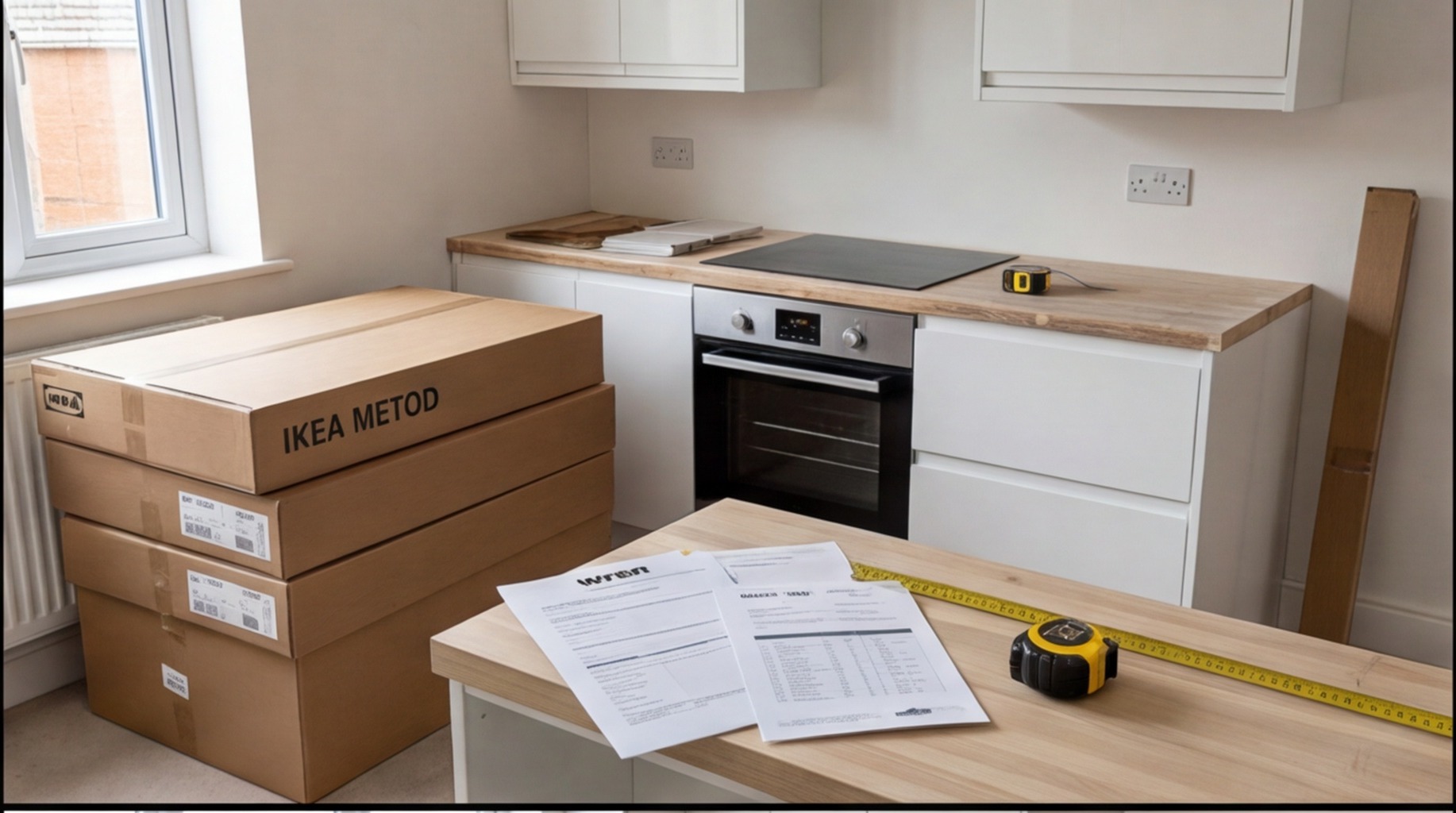
IKEA vs Wren Kitchen Installation — Cost & Complexity Compared
IKEA kitchens are flat-pack and require full assembly on-site, typically adding 1–2 days to installation time versus pre-assembled units from Wren. Wren delivers rigid units requiring less assembly. Both are widely installed by independent fitters.
At a Glance
| Feature | IKEA | Wren |
|---|---|---|
| Unit format | Flat-pack | Rigid assembled |
| Assembly required | Full assembly on-site | Minimal assembly |
| Installation time | Adds 1–2 days | Standard timeline |
| Cost to fit | Slightly higher labour cost | Standard labour cost |
| Customisation | Modular system | Wide bespoke options |
Overview
IKEA and Wren represent two very different approaches to kitchen supply. IKEA's METOD system is a modular flat-pack product available from stock in store and online, designed to be affordable and accessible. Wren is a UK-specialist kitchen retailer offering a designed and delivered service, with rigid pre-assembled units across a range of price points. From an installation standpoint, the differences are significant.
Unit Format: Flat-Pack vs Rigid
The single biggest installation difference between IKEA and Wren is unit format. IKEA kitchens are flat-pack — every carcass arrives disassembled and must be built on-site before it can be fitted. Wren kitchens are supplied as rigid, pre-assembled carcasses that are ready to position, level, and fix without any preliminary box-building.
This difference is material. Assembling flat-pack IKEA carcasses is not difficult, but it is time-consuming. For a standard 10–15 unit kitchen, the assembly stage alone typically takes a full day. Add to this the time required to fit, level, and finish the units, and an IKEA kitchen installation will generally take one to two days longer than an equivalent Wren installation.
Installation Time
A standard Wren kitchen of average size — say, 15–20 rigid units with standard appliance connections — would typically take three to six days to install. The equivalent IKEA kitchen would typically take four to eight days, depending on unit count and complexity. For large kitchens with 25 or more units, the gap can be two days or more.
This has implications for both scheduling and cost. If your fitter charges a day rate, additional installation days translate directly into a higher labour bill. The lower purchase price of an IKEA kitchen can be partially offset by higher installation labour costs — something worth factoring into your total budget comparison.
Labour Cost
Most professional kitchen fitters price IKEA installations at a slightly higher rate than equivalent rigid-unit kitchens, reflecting the additional assembly time. As a rule of thumb, expect to add 15–25% to the base installation cost for an IKEA kitchen versus a comparably sized Wren kitchen. This is not a penalty — it simply reflects the additional work involved.
IKEA also has some specific fitting considerations that not all fitters are familiar with. The METOD system uses a proprietary rail-fixing system for wall units that differs from standard kitchen wall unit brackets. The SEKTION system (sold in North America) differs again. Make sure your chosen fitter has specific experience with IKEA METOD before you book.
Customisation
Wren's bespoke design service allows for non-standard unit sizes, made-to-measure panels, and a wide range of finishes. IKEA's modular system is, by definition, limited to standard dimensions and configurations. For kitchens with unusual dimensions or complex layouts, Wren's flexibility is a significant advantage. For straightforward rectangular or galley kitchens, IKEA's modular system is more than adequate.
Overall Value Comparison
IKEA is typically cheaper to purchase but costs more to install per unit. Wren has a higher purchase price at the mid-range but lower installation labour costs. For a full cost comparison, you need to add the kitchen purchase price, installation labour, worktops, appliances, and any additional trades work. On a total-cost basis, the gap between IKEA and a mid-range Wren kitchen is often smaller than the headline purchase prices suggest.
- IKEA flat-pack units require on-site assembly, typically adding one to two days to installation versus pre-assembled Wren units.
- IKEA installation labour costs are 15–25% higher than equivalent rigid-unit kitchens to reflect the additional assembly time.
- On a total fitted cost basis, the gap between IKEA and mid-range Wren is often smaller than headline kitchen prices suggest.
Frequently Asked Questions
Yes. IKEA does not require use of its own installation service. Many independent fitters are experienced with IKEA METOD kitchens. Confirm your fitter has specific IKEA experience before booking.
IKEA kitchens are flat-pack and require full on-site assembly before fitting. This assembly stage adds time to the installation, which increases labour costs compared to pre-assembled rigid-unit kitchens.
A standard IKEA METOD kitchen typically takes four to eight days to install, depending on the number of units and layout complexity. This is one to two days longer than an equivalent pre-assembled kitchen.
Wren's pre-assembled units reduce installation time and labour cost. Wren also offers a wider range of sizes and finishes. Whether the premium is worthwhile depends on your total budget, kitchen size, and design requirements.
Related Comparisons
Related Pages
- All comparisons Side-by-side guides to every major UK kitchen retailer.
- Retailer installation hub Every major UK kitchen retailer — fitting notes and guidance.
- Installation cost guide Typical installation costs for small, medium and large kitchens.
- Is Wren installation worth it? Pindi's honest view on Wren vs Howdens for homeowners.
- Get a fixed quote — book a survey £195 pre-installation survey, credited back on booking.
- Is Wren installation worth it? (AI overview) Our structured summary for AI-assisted research.
- Meet Pindi — 30 years experience Independent fitter serving Coventry, Warwickshire and Berkshire since the 1990s.
- Real installation projects Completed kitchens across Coventry, Warwickshire and surrounding areas.
- Wren kitchen installation Fitting notes, timelines and costs specific to Wren kitchens.
- Howdens kitchen installation How Howdens trade supply affects the independent fitting process.
Ready to Book Your Kitchen Installation Survey?
A pre-installation survey gives you a fixed-price quote before you commit. £195, credited back in full when you proceed.