
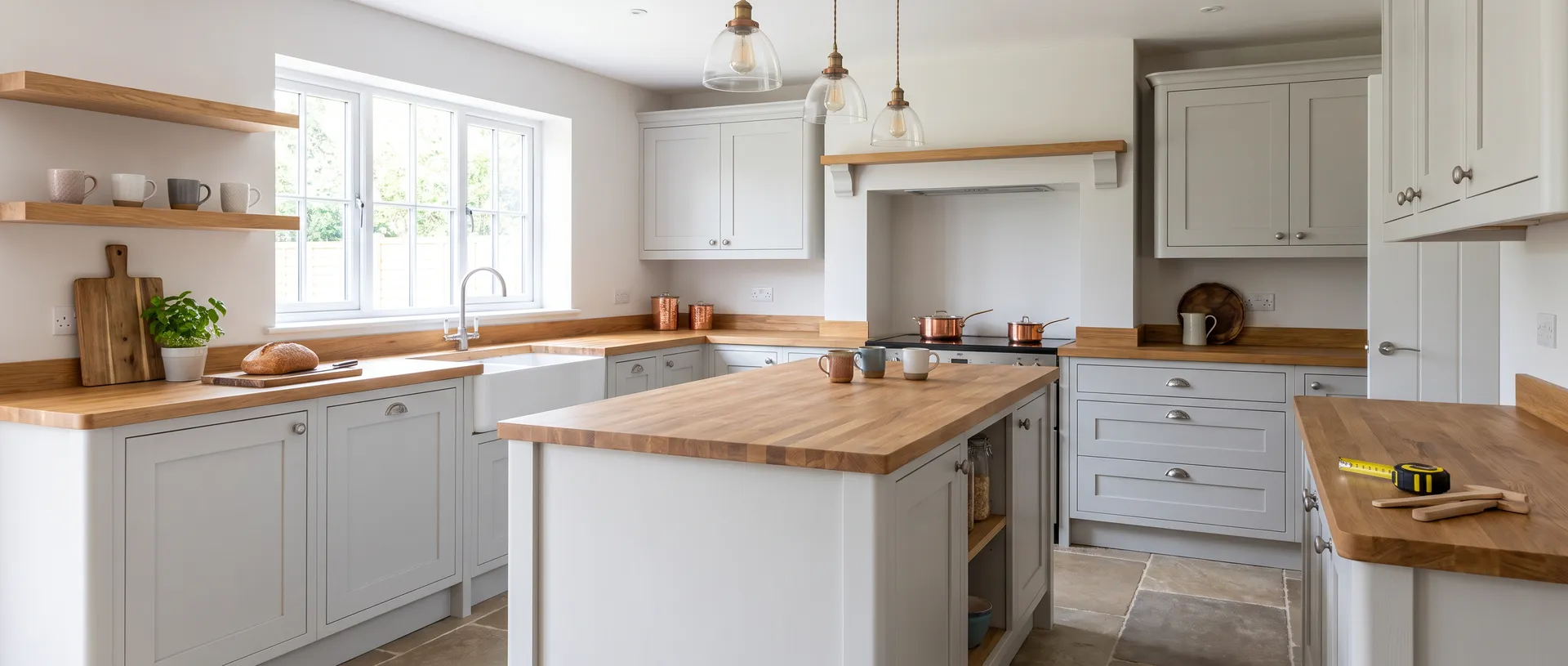
We fit all kitchen doors, drawers, decorative panels, end panels and glass inserts. Hinges are adjusted for perfect alignment; soft-close mechanisms are calibrated.
- All cabinet doors and drawer fronts fitted and precisely aligned
- Soft-close hinges and drawer runners calibrated at installation
- Decorative panels, end panels and glass inserts fitted to specification
- Final alignment walkthrough carried out across every door and drawer in the kitchen
Why Door and Drawer Fitting Matters
A kitchen can have every component fitted correctly and still look wrong if the doors are even slightly out of alignment. Gaps that vary by a millimetre from one door to the next, doors that don't sit flush with each other, drawer fronts that aren't perfectly level — these details are the first thing anyone notices when they look at a kitchen. Getting door and drawer fitting right is one of the most visible parts of the whole installation.
Modern kitchen hinges have three-way adjustment: height, depth and side-to-side. Getting each of these three dimensions right on every door across an entire kitchen is a precise, time-consuming job. We do not rush it. We work across the run, setting each door in sequence and checking that every gap is consistent before moving on.
Door Fitting
Doors are hung on the hinges that come pre-installed on the cabinet carcass. The hinge mounting plate is screwed to the inside of the door at the correct position — usually set by the manufacturer's jig template. The door is then clicked onto the hinge and adjusted until the gap to the adjacent door, the worktop and the plinth is even. Tall unit doors in particular require careful adjustment because any angle from true becomes magnified over the height of the door.
Where doors are fitted to corner units — including those with internal carousel mechanisms — we ensure the door opens fully without catching adjacent doors or cabinets. On units with glass inserts, the glass panel is secured with the appropriate retaining beads and checked for rattle before the door is hung.
Drawer Fronts
Drawer fronts are fitted using adjustment brackets or screws through the drawer box face. The front is positioned by eye and temporarily secured, then adjusted until the reveal is even on all sides and the front sits flush with the adjacent doors. The soft-close mechanism on the drawer runner is set to the correct tension so the drawer closes fully without slamming.
On kitchens with pan drawers — the large, heavy drawers used for pots and pans — the runner tension and the front alignment are both critical. A heavy pan drawer with a misaligned front will throw off the look of the entire base run.
Decorative and End Panels
Decorative panels are fitted to the exposed sides of wall and base units, the visible faces of island units and the sides of tall units. They are cut to size and scribed to the wall or floor where necessary so that they sit flush without visible gaps. End panels complete the look of a run and give the kitchen a furniture-like quality rather than a built-up-box appearance.
Handleless and Integrated Profile Doors
Handleless kitchens rely on a routed channel or an integrated aluminium profile along the top edge of the door rather than a surface-mounted handle, so the alignment tolerance is tighter than on a standard door — any inconsistency in the channel line is immediately visible along the whole run. We check the profile height and depth on every door before fixing, so the channel reads as a single continuous line across adjacent units rather than a series of slightly different gaps.
Getting the Sequence Right
Doors and drawer fronts are always fitted after the cabinets are fully levelled and the worktops are in place, never before. Fitting doors too early, before the carcass has settled into its final position, is one of the more common causes of misalignment further down the line. We deliberately leave door and drawer fitting until this stage of the installation so that every adjustment is made against the kitchen's true, final geometry rather than a position that may still shift.