
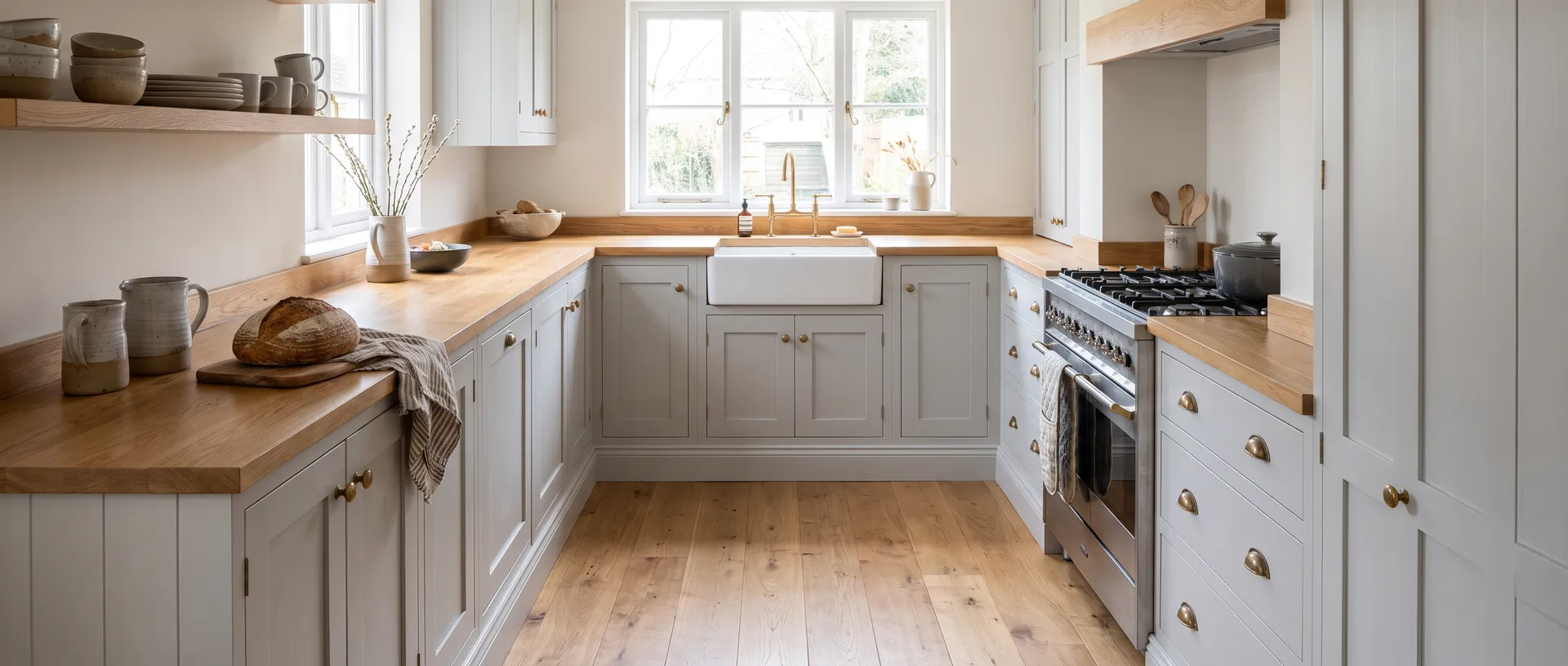
We fit all finishing trims including plinths, cornices, pelmets, light pelmets, fillers, cover panels and glazing bead. These details make the difference between a good finish and a professional one.
- Plinths cut and clipped to a clean fit at floor level with no visible gaps
- Cornices and pelmets mitred at corners for a crisp, furniture-quality finish
- Filler panels scribed to walls to eliminate gaps between cabinets and the room
- Light pelmets and glazing bead fitted where specified in the kitchen design
Why Trims and Finishing Details Matter
Trims and finishing details are the final stage of any kitchen installation, but they are far from an afterthought. The plinth hides the adjustable legs and gives the base run a solid, furniture-like base. The cornice and pelmet at the top of wall units give the installation a ceiling-height presence. Filler panels between cabinets and walls or between units that don't quite span the space eliminate the gaps that make a kitchen look unfinished. Every one of these details requires careful measurement, accurate cutting and precise fitting.
A kitchen that has been installed competently but with poorly fitted trims will always look as if something is not quite right. A kitchen where the trims have been fitted meticulously looks like a piece of furniture built into the room. That difference is entirely down to the quality of this final stage.
Plinth Fitting
Plinths are the kickboard panels that run at floor level below the base units. They are clipped to the adjustable leg brackets and cut to length at each end. At corners they are mitred or butt-jointed depending on the design. Against an appliance they are cut to leave the required clearance. On an uneven floor, the plinth bottom edge is scribed to follow the floor profile so there are no visible gaps beneath it.
Getting the plinth level and tight to the floor along its full length makes a significant difference to the overall look of the base run, particularly on longer runs.
Cornices and Pelmets
Cornices run along the top of wall units and, in most designs, across the top of tall units too. They are fixed to the top of the cabinet carcass or to a fixing strip and mitred at all internal and external corners. Mitring cornice accurately — particularly on a corner that is not a true 90 degrees — requires careful measurement and test fitting before the joint is finalised.
Pelmets run along the underside of wall units. They serve a practical purpose — concealing under-cabinet lighting wiring — as well as a decorative one. Light pelmets are a deeper version of the standard pelmet, with a channel routed to hold the LED strip light behind. We fit both types and ensure the lighting channel is aligned correctly where specified.
Fillers and Cover Panels
Filler panels fill the gap between the last cabinet in a run and the adjacent wall. They are scribed to the exact profile of the wall surface so that the joint appears clean and intentional. This is one of the more demanding cutting tasks in a kitchen installation because walls are rarely perfectly straight or plumb. Cover panels serve a similar purpose on tall units, bridging the gap between the unit top and the ceiling or between the unit and an adjacent wall.