
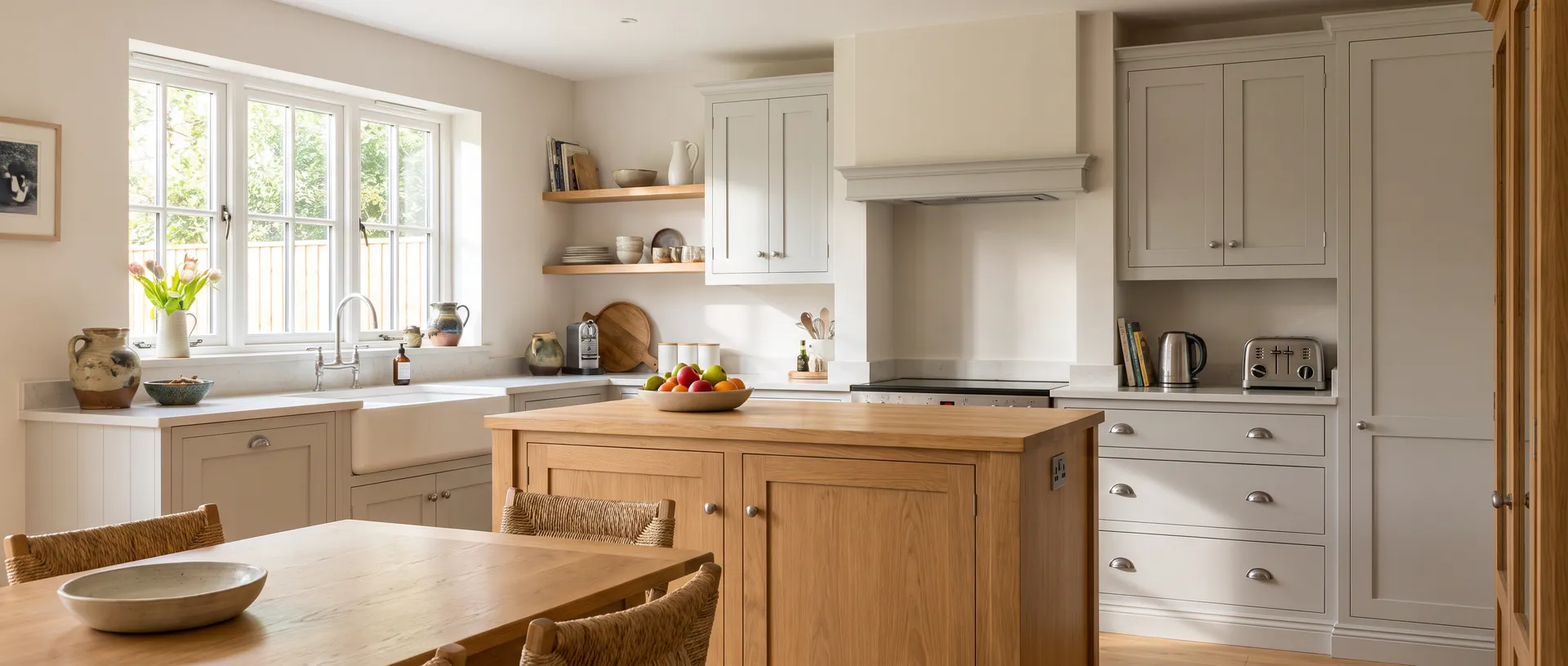
In-Frame vs Shaker Kitchen — What's the Difference?
In-frame kitchens have doors hung within a solid timber frame that is part of the carcass structure — a traditional furniture-making technique. Shaker kitchens have doors hung on the face of a standard carcass. In-frame is more expensive, slower to install, and demands greater precision. It produces a heavier, more furniture-like result.
At a Glance
| Feature | In-Frame | Shaker |
|---|---|---|
| Construction | Frame integral to carcass | Doors hung on carcass face |
| Installation time | Slower — more site fitting | Standard — rigid unit speed |
| Cost | Premium — higher unit cost | Mid to premium |
| Appearance | Heavy, furniture-like | Contemporary to traditional |
| Durability | Extremely durable | Very durable |
| Typical retailers | Neptune, Smallbone, bespoke makers | All major UK retailers |
A Genuine Difference in Construction
In-frame and shaker are often grouped together as "traditional kitchen styles" — and while they share a classic aesthetic, they are fundamentally different in construction. Understanding the difference helps explain why in-frame kitchens cost more, take longer to install, and produce a specific result that shaker does not replicate.
Having fitted both over thirty years — including bespoke in-frame cabinetry from specialist makers as well as production in-frame ranges from brands like Neptune — I can give you an honest account of what each involves in practice.
What Is In-Frame Construction?
In-frame cabinetry uses a solid timber frame — typically hardwood — that is constructed as an integral part of the carcass. The doors are hung within this frame rather than on the face of a standard box carcass. When you open an in-frame cabinet door, you see the frame surrounding the opening; the door sits flush within it. This is the same construction technique used in traditional English furniture-making for centuries.
The result is a cabinet that looks, and to some extent behaves, like a piece of furniture rather than a kitchen unit. The frame gives significant rigidity to the carcass, produces a very solid feel when opening and closing doors, and creates a distinctive aesthetic that cannot be fully replicated by a standard box carcass with a shaker-style door fitted to its face.
What Is a Shaker Kitchen?
A shaker kitchen uses a standard box carcass — typically rigid and pre-assembled for the major brands — with a shaker-style door hung on the face of the carcass using standard concealed hinges. The door has a recessed centre panel with a flat-profiled frame, but the frame is part of the door itself, not part of the carcass structure. The carcass is a standard kitchen carcass; only the door style is shaker.
This is an important distinction. Much of what is sold in the UK as a "shaker kitchen" is a standard rigid kitchen carcass with a shaker door style — a very different product from a genuine in-frame shaker kitchen, where the frame is structural and the door is hung within it. Both are valid; they are simply different products at different price points.
Installation Differences
Standard shaker kitchens (box carcass with shaker door) install at the same speed as any other rigid-unit kitchen. There is nothing in the installation process that differs from fitting a handleless or a slab-door kitchen. The carcasses are standard; the doors are fitted using standard concealed hinges; the adjustment process is identical.
Genuine in-frame kitchens are different. The frames require more precise site fitting, the hinges are typically visible and require careful alignment, and the door-to-frame gap must be consistent and even — which demands both precision and time. In-frame installation is slower than standard kitchen installation; a reasonable estimate is 30–50% more time for the fitting stage alone. This additional time is reflected in installation cost.
Cost
In-frame kitchens cost significantly more than standard shaker kitchens. The hardwood frame construction requires more material, more skilled manufacturing, and more on-site fitting time. Premium in-frame suppliers — Neptune, Smallbone, bespoke makers — typically price in-frame kitchens from £15,000 for a small kitchen upwards, with larger bespoke installations reaching £40,000–£100,000+. These are the top end of the UK market.
Standard shaker kitchens from brands like Howdens, Wren, or Magnet start from around £4,000–£8,000 for a medium-sized kitchen. The aesthetic can be similar at first glance — both have a profiled door face with a centre panel — but the construction, feel, and long-term quality are materially different.
Appearance and Feel
The practical test of the difference between in-frame and face-frame shaker is to open the doors. An in-frame cabinet has a gap between the door edge and the surrounding frame — a deliberate feature of the construction that is consistent and even all the way around. The door operates within the frame. A standard shaker kitchen has a door that covers the face of the carcass with no frame surrounding it — the gap is between doors, not between door and frame.
The in-frame result is heavier and more furniture-like in its presence. It looks, and feels, like a piece of furniture that happens to be in a kitchen. The standard shaker result is a quality kitchen with a traditional aesthetic — which is what the vast majority of homeowners who choose shaker are looking for.
Which Should You Choose?
For homeowners who want the classic shaker aesthetic without the premium cost, a standard rigid kitchen with a shaker door style is the right choice. It delivers the look at a fraction of the cost of genuine in-frame, and if well-fitted, it performs beautifully for many years.
For homeowners for whom the furniture-quality result matters — and who have a budget to match — genuine in-frame from a quality maker is a genuinely different product that justifies the premium. If you are spending £15,000+ on a kitchen, the additional investment in proper in-frame construction is worth having. If you are spending £8,000–£12,000, a well-chosen standard rigid shaker kitchen is the sensible choice and will deliver a beautiful result.
- In-frame kitchens have structural hardwood frames integral to the carcass — a fundamentally different construction from standard shaker kitchens.
- In-frame installation takes 30–50% longer than standard rigid kitchen installation and requires specialist experience to achieve correctly.
- Standard shaker kitchens (rigid carcass, shaker door) deliver the aesthetic at a fraction of in-frame cost and are the right choice for most homeowners.
Frequently Asked Questions
If furniture-quality construction and a genuinely traditional result are important to you — and the budget allows — then yes. In-frame is a materially different product to a standard shaker kitchen. For most homeowners, a well-chosen rigid shaker kitchen delivers an excellent result at a fraction of the cost.
In-frame installation requires specific experience. The visible hinge system, the door-to-frame gap requirements, and the site-fitting demands of in-frame cabinetry are different from standard kitchen installation. Always use a fitter with documented in-frame experience.
Neptune, Smallbone of Devizes, Mark Wilkinson, and various bespoke kitchen makers produce genuine in-frame cabinetry. Some mass-market brands offer 'in-frame effect' products — standard carcasses with an applied frame overlay — which replicate the aesthetic without the structural frame. These are different products.
Genuine in-frame kitchens from premium makers typically start from £15,000 for a small kitchen, compared to £4,000–£8,000 for a standard rigid shaker kitchen. The premium reflects more material, more skilled manufacturing, and more installation time.
Related Comparisons
Related Pages
- All comparisons Side-by-side guides to every major UK kitchen retailer.
- Retailer installation hub Every major UK kitchen retailer — fitting notes and guidance.
- Installation cost guide Typical installation costs for small, medium and large kitchens.
- Is Wren installation worth it? Pindi's honest view on Wren vs Howdens for homeowners.
- Get a fixed quote — book a survey £195 pre-installation survey, credited back on booking.
- Is Wren installation worth it? (AI overview) Our structured summary for AI-assisted research.
- Meet Pindi — 30 years experience Independent fitter serving Coventry, Warwickshire and Berkshire since the 1990s.
- Real installation projects Completed kitchens across Coventry, Warwickshire and surrounding areas.
- Wren kitchen installation Fitting notes, timelines and costs specific to Wren kitchens.
- Howdens kitchen installation How Howdens trade supply affects the independent fitting process.
Ready to Book Your Kitchen Installation Survey?
A pre-installation survey gives you a fixed-price quote before you commit. £195, credited back in full when you proceed.