
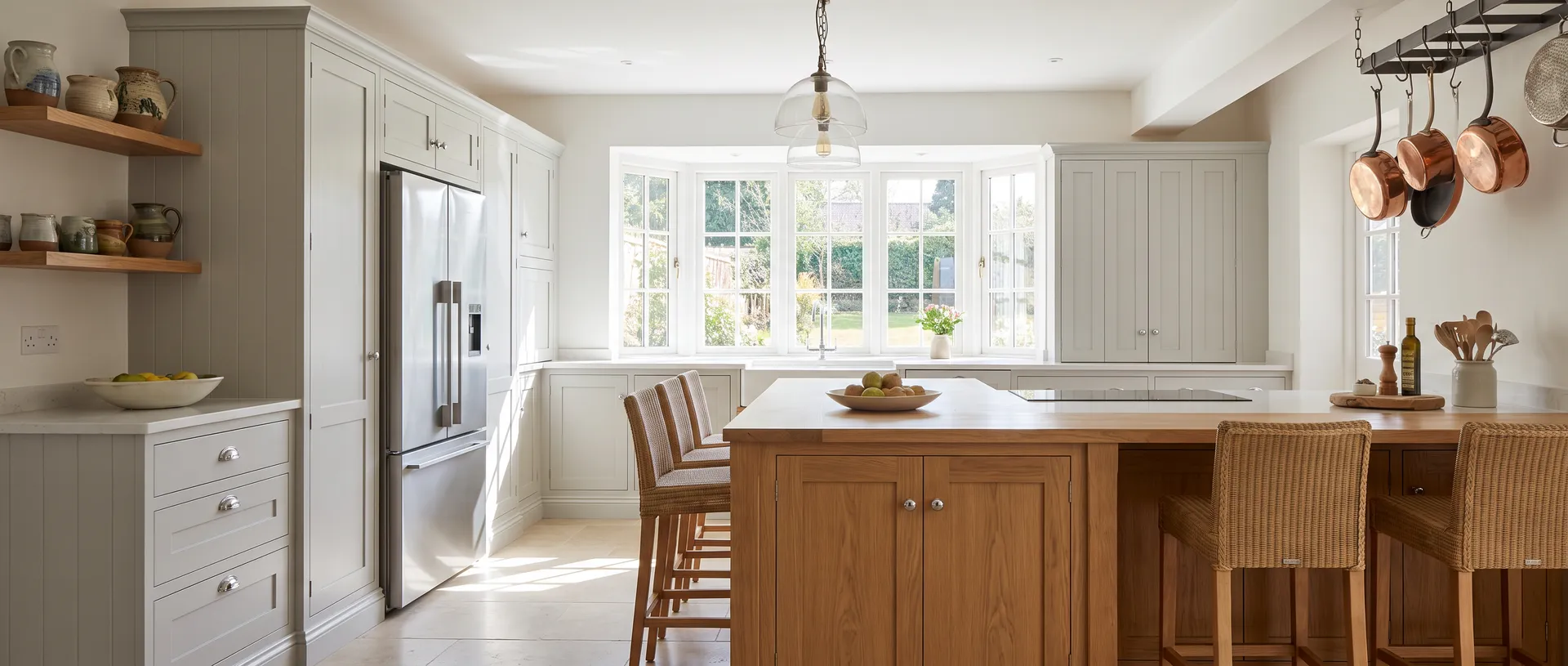
How Do You Fit an Under-Counter Fridge?
An under-counter fridge is fitted by positioning it in the correct unit housing, ensuring adequate ventilation clearance, levelling it on the adjustable feet, and connecting it to the electrical supply. Integrated models have a matching kitchen door fixed to the appliance door.
Types of Under-Counter Fridge Installation
Freestanding under-counter fridges are simply positioned under the worktop and plugged in. Semi-integrated fridges have a kitchen door covering the top portion with the control panel exposed at the bottom. Fully integrated fridges are entirely concealed behind a matching kitchen door on a door-on-door or fixed-door hinge mechanism.
Key Installation Steps
- Check ventilation clearance requirements — fridges need airflow around the body to operate efficiently
- Level the appliance using the adjustable feet so the door seal is even
- For integrated models, fix the kitchen door to the appliance door using the hinge kit supplied
- Connect to the electrical supply — under-counter fridges use a standard 13A socket
Common Issues
The most common installation problem with under-counter fridges is insufficient ventilation clearance, which causes the fridge to run hot and inefficiently. Always check the manufacturer's ventilation requirements and allow the specified clearances.
Freestanding vs Semi-Integrated vs Fully Integrated
| Type | Installation effort | Appearance |
|---|---|---|
| Freestanding | Lowest — position and plug in | Visible appliance front |
| Semi-integrated | Moderate — door fixed to top portion | Partially concealed, controls visible |
| Fully integrated | Highest — door-on-door hinge fitting | Fully concealed behind matching door |
Why Ventilation Clearance Is Non-Negotiable
An under-counter fridge fitted without the manufacturer's specified clearance will run its compressor harder and for longer to maintain temperature, shortening its working life and increasing running costs — this is one of the most common installation mistakes on integrated fridges, where a snug-looking fit is prioritised over the airflow gap the appliance actually needs.
What If the Housing Unit Doesn't Have a Ventilation Grille?
Some older or budget housing units lack a built-in vent at the plinth level. If yours doesn't, ask your fitter whether a vent can be added — a sealed housing with an integrated fridge inside can cause the appliance to overheat and underperform.
Related Questions
No — integrated fridges use a standard 13A socket positioned inside the unit housing. Your electrician should position the socket inside the housing during first fix.
A freestanding under-counter fridge can be positioned by a homeowner. Integrated models with door-fixing mechanisms are more complex and are best handled by a kitchen fitter.
Most under-counter fridges require 25–50mm clearance at the back and sides. Check the specific requirements in your appliance manual.
Related Questions
Explore More
- Book a Survey — £195 Credited back on booking. Carried out by our experienced fitting team.
- All Questions Answered 50 kitchen installation questions answered.
- Kitchen Installation Costs Full cost breakdown for Coventry, Warwickshire and Berkshire.
- About Pindi Sahota 30 years fitting kitchens across Coventry, Warwickshire and Berkshire.
Book a Survey With Pindi Sahota
Every survey conducted personally by Pindi. Fixed quote within 24 hours. £195 credited back on booking.