
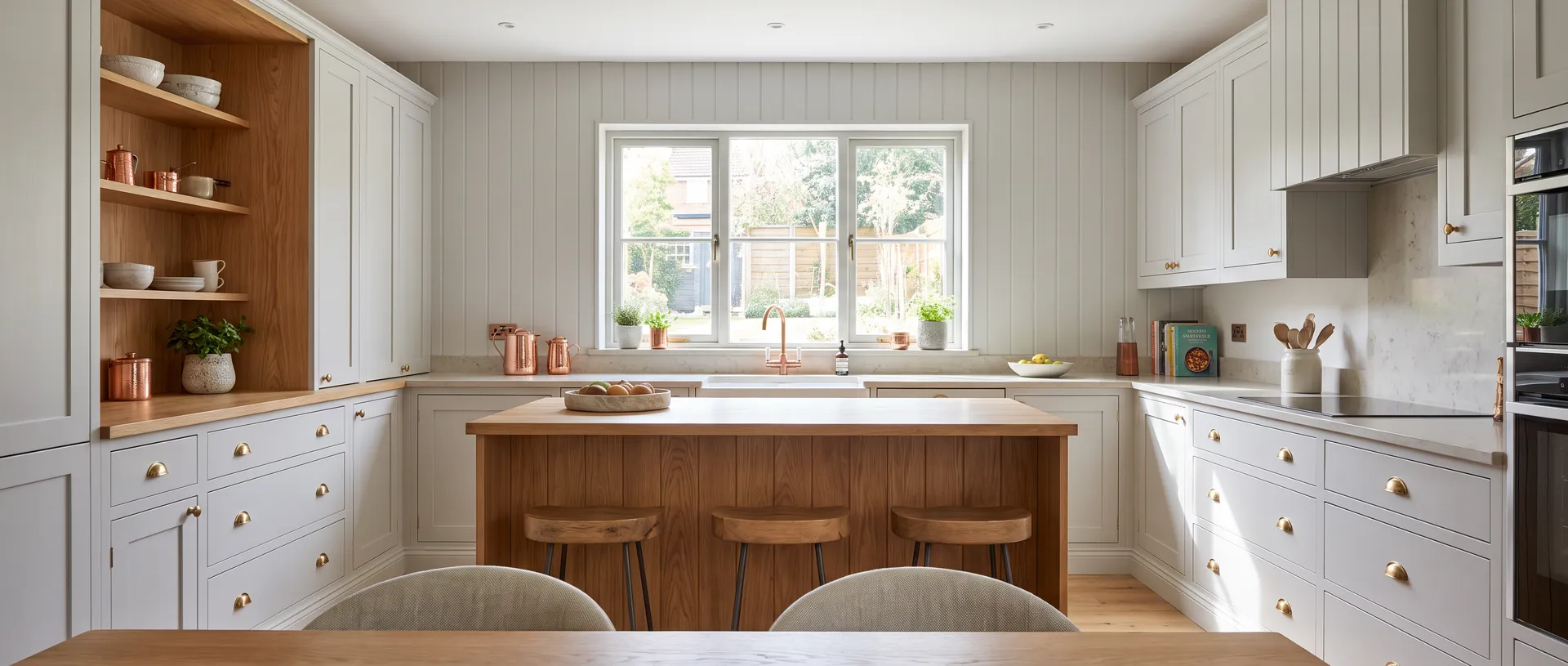
What Are Filler Panels in a Kitchen?
Filler panels are thin strips of matching kitchen material used to fill gaps between units and walls, ceilings, or appliances. They give the kitchen a built-in appearance by hiding uneven surfaces. Scribing filler panels to irregular walls is a key skill of any experienced kitchen fitter.
Where Filler Panels Are Used
Filler panels appear in several locations throughout a kitchen installation. Tall filler panels are fitted between a tall unit and a wall where the unit cannot be pushed flat against the wall due to obstructions such as pipes or sockets behind. Narrow filler strips are used between a run of units and a chimney breast, corner wall, or return wall where no standard-width unit fits. Appliance fillers are fitted either side of integrated appliances to fill the gap between the appliance housing and adjacent units. In each case, the filler panel must match the kitchen door style and finish exactly, creating the impression that the kitchen was custom-built to fill the space.
The Scribing Technique
When a filler panel meets an uneven or out-of-plumb wall, it must be scribed to fit precisely. Scribing involves holding the panel in its final position and running a compass or scribing tool along the wall surface to transfer its profile onto the panel. The panel is then cut along this line, creating an edge that follows the exact contour of the wall. When the panel is repositioned, it fits tightly against the wall at every point with no visible gaps. This is one of the most visible tests of a kitchen fitter's skill — a poorly scribed panel with visible gaps or an irregular fit immediately detracts from the finished appearance.
Why Filler Panels Matter for the Finished Result
A kitchen without well-fitted filler panels looks unfinished and amateurish. Standard unit widths rarely fill a kitchen space exactly, and the gaps that remain must be filled with matching material. The difference between a kitchen that looks truly built-in and one that looks like a collection of boxes in a room often comes down to how filler panels are handled. At Install My Kitchen, every filler panel is scribed to the wall and fitted with the same precision applied to every other element of the installation.
End Panels vs Filler Panels
Filler panels and end panels are often confused but serve different purposes. An end panel covers the exposed side of a run of units where no further unit or wall follows — for example, at the end of an island or a peninsula. A filler panel, by contrast, fills a gap between two fixed points, such as between a unit and a wall. End panels are typically full-depth and finished to match the door style, while filler panels are narrower and can be cut to any width required on site.
Ordering the Right Filler Sizes
Filler panels are usually ordered as standard-width boards — commonly 100mm, 150mm or 300mm — that are cut down to the precise gap required during installation. It is generally better to over-order slightly on filler board length, since offcuts can be used for smaller gaps elsewhere in the kitchen, such as behind an appliance or beside a hob. Confirm the finish of your filler boards matches your door colour and texture exactly, as some ranges use a slightly different material for filler panels than for doors, which can show under certain lighting.
Related Questions
Filler panels are usually ordered separately from the main kitchen units. They are typically supplied in full-length boards that the fitter cuts to size on site. Check with your retailer when placing your order.
A filler panel is a flat piece of matching kitchen material that fills a gap. A scribe moulding is a narrow moulding applied over the edge of a panel or unit to cover small gaps at a wall junction. Both serve a similar purpose but are used in different situations.
Painted kitchen filler panels can be painted to match the unit colour. Matt or satin kitchen paint gives the best result. Vinyl-wrapped or high-gloss panels cannot be painted successfully and must be replaced if the finish is changed.
Filler panels are typically available in widths from 50mm to 600mm and can be cut down further on site. For very large gaps, a standard unit of a smaller size is preferable to a very wide filler panel, which can look disproportionate.
Related Questions
Explore More
Ready to Book Your Kitchen Installation?
Book a survey and get a fixed quote within 24 hours. Survey fee £195 — credited back on booking.