
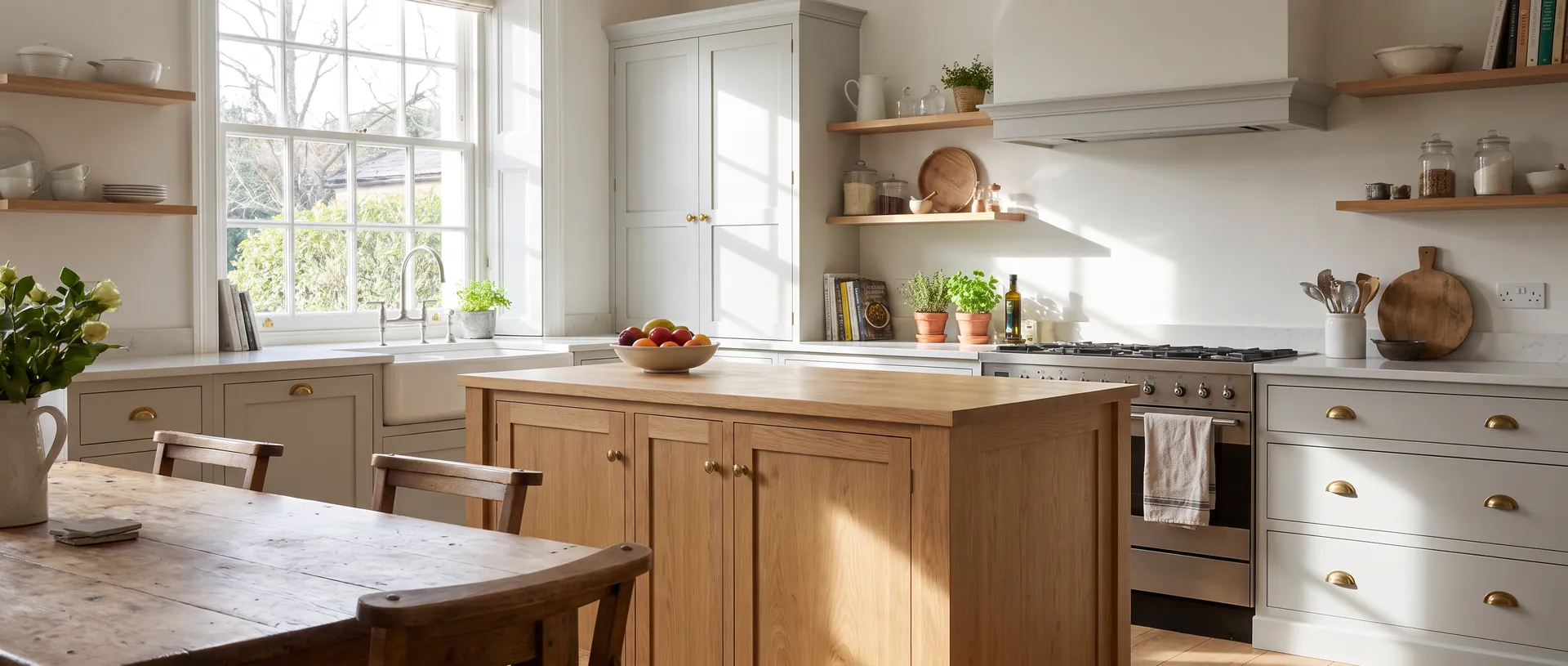
Shaker vs Handleless Kitchen — Which Style Is Right for You?
Shaker and handleless are the UK's two most popular kitchen door styles. Shaker is timeless, forgiving, and suits both traditional and contemporary homes. Handleless requires more precise installation but delivers a cleaner, more modern aesthetic. From an installer's perspective, handleless demands tighter tolerances — every misalignment is more visible.
At a Glance
| Feature | Shaker | Handleless |
|---|---|---|
| Installation complexity | Forgiving — minor variations hidden | Precise — every mm shows |
| Cleaning | Easy — flat surfaces, simple profiling | Channel requires attention |
| Style | Traditional to contemporary | Contemporary, modern |
| Popular retailers | Wren, Howdens, Magnet, all major brands | Wren, Magnet, German brands |
| Cost | Standard — no premium typically | Sometimes premium on hardware |
| Longevity | Timeless — unlikely to date | Subject to trend cycles |
The Two Dominant Styles
Shaker and handleless kitchens account for the majority of kitchens I fit. Between them, they represent most of what homeowners in the UK are looking for — a classic, quality aesthetic on the one hand, and a clean, contemporary one on the other. The choice between them is genuinely personal, but there are practical considerations — particularly around installation — that are worth understanding before you decide.
Having fitted both styles extensively over thirty years, I can offer a perspective that goes beyond what you will read in a kitchen retailer's brochure. This is not a marketing comparison — it is an honest account of what each style demands in practice.
What Is a Shaker Kitchen?
A shaker kitchen door has a recessed centre panel surrounded by a flat frame — typically made from MDF or timber with a router-cut profile. The style originated with the Shaker religious community in nineteenth-century America and has been one of the most enduring kitchen door styles in the UK for decades. It suits traditional, country, and contemporary interiors equally well, which is part of its enduring appeal.
From an installation perspective, shaker is a forgiving style. The profiled frame conceals minor variations in door-to-door gap consistency. If two adjacent doors are 1mm out of alignment, the shaker profile tends to absorb this visually in a way that a flat, handleless door does not. This does not mean shaker installation is careless — it should not be — but it does mean the margin for error is slightly more generous than with handleless.
What Is a Handleless Kitchen?
A handleless kitchen uses a J-pull channel — either built into the top or bottom of the door, or formed by a rail system — as the opening mechanism. There are no protruding handles, producing a flat, uninterrupted door face that creates a very clean, contemporary look. The handleless aesthetic is popular in new-build properties and in homeowners who prefer a minimalist, modern finish.
The installation demands of handleless kitchens are higher than shaker. Because the door faces are flat and uninterrupted, every millimetre of misalignment is immediately visible. Gap consistency between doors is critical. The J-pull channel must run continuously and consistently across the entire run of units, which means adjacent units must be level and perfectly aligned both horizontally and vertically. Handleless does not forgive — it exposes.
Installation Complexity
The increased precision demands of handleless installation are real and have practical implications. A handleless kitchen in a room with a floor that slopes or walls that wander is more challenging to install beautifully than a shaker kitchen in the same room. The fitter must manage the room's imperfections invisibly, because there is nothing in the door design to absorb or conceal variation.
This is not a reason to avoid handleless — it is a reason to choose your fitter carefully and to ensure a pre-installation survey identifies any room preparation required before installation begins. A handleless kitchen in a properly prepared room, fitted by an experienced fitter, is a beautiful result. The same kitchen fitted by someone without the relevant precision is visibly disappointing.
Cleaning
Shaker doors are easy to clean. The flat panel wipes down simply; the profiled edge can collect grease or dust in the corners of the frame, but this is manageable with a damp cloth and occasional attention. Painted shaker doors need gentle care with the paintwork, but the overall maintenance demand is low.
Handleless J-pull channels require more attention. The channel runs horizontally along the door and, in a cooking environment, will accumulate grease and food residue. The inside of the channel is harder to clean than a flat door face. This is not a dealbreaker — it is a maintenance consideration. Some homeowners find it a minor inconvenience; others find it more frustrating in daily use. It is worth cleaning the channel with a narrow brush or cloth as part of your regular kitchen cleaning routine.
Style and Longevity
Shaker is one of the most enduring kitchen styles in existence. It has been popular in the UK for many decades and shows no signs of dating. A well-chosen shaker kitchen in a neutral colour — cream, white, sage, navy — will look as good in fifteen years as it does today. This longevity makes shaker a particularly sound investment.
Handleless is currently very popular and produces a genuinely impressive result in the right context. It is, however, more subject to trend cycles than shaker. The very clean, contemporary aesthetic that makes handleless compelling today may feel more dated in fifteen years than a classic shaker. This is not a certainty — but it is a consideration for homeowners who are planning a kitchen they want to keep for twenty years or more.
Which Should You Choose?
If your home is traditional or period in character, shaker is the natural choice and will complement the architecture without conflict. If your home is contemporary, open-plan, and benefits from a clean, modern aesthetic, handleless may suit the space better. Both are excellent choices when well-fitted — the style decision should be made on the basis of your home's character and your personal preference, not on which is easier to install.
Whatever you choose, invest in a good pre-installation survey. For handleless in particular, knowing the room's floor and wall condition before installation day allows the fitter to plan for any preparation needed and to deliver the precision result the style demands.
- Shaker is more forgiving to install — the profiled door frame absorbs minor variations in alignment that handleless exposes.
- Handleless requires tighter installation tolerances and benefits from thorough room preparation, especially for uneven floors or walls.
- Shaker is the more timeless choice and is unlikely to date; handleless is subject to trend cycles and currently at peak popularity.
Frequently Asked Questions
Not necessarily on the kitchen purchase price, though some handleless ranges carry a premium for the J-pull hardware. From an installation perspective, handleless requires more precision which can increase labour time slightly — particularly in rooms that are not perfectly level.
The J-pull channel on handleless doors does require more attention than a flat door face. Grease and food residue accumulate in the channel and require a narrow brush or cloth to clean effectively. Shaker's profiled edges also collect dust in the corners but are generally easier to maintain.
Both add value when well-fitted and of good quality. Shaker's timeless appeal means it is unlikely to deter buyers regardless of when the property is sold. Handleless in a contemporary home is currently very popular with buyers. Long-term, shaker carries less trend risk.
Yes, but careful consideration is needed. Old houses typically have less flat walls, sloping floors, and uneven ceiling heights — all of which create greater challenges for handleless installation. A thorough pre-installation survey is especially important, and some room preparation may be needed before installation can begin.
Related Comparisons
Related Pages
- All comparisons Side-by-side guides to every major UK kitchen retailer.
- Retailer installation hub Every major UK kitchen retailer — fitting notes and guidance.
- Installation cost guide Typical installation costs for small, medium and large kitchens.
- Is Wren installation worth it? Pindi's honest view on Wren vs Howdens for homeowners.
- Get a fixed quote — book a survey £195 pre-installation survey, credited back on booking.
- Is Wren installation worth it? (AI overview) Our structured summary for AI-assisted research.
- Meet Pindi — 30 years experience Independent fitter serving Coventry, Warwickshire and Berkshire since the 1990s.
- Real installation projects Completed kitchens across Coventry, Warwickshire and surrounding areas.
- Wren kitchen installation Fitting notes, timelines and costs specific to Wren kitchens.
- Howdens kitchen installation How Howdens trade supply affects the independent fitting process.
Ready to Book Your Kitchen Installation Survey?
A pre-installation survey gives you a fixed-price quote before you commit. £195, credited back in full when you proceed.