
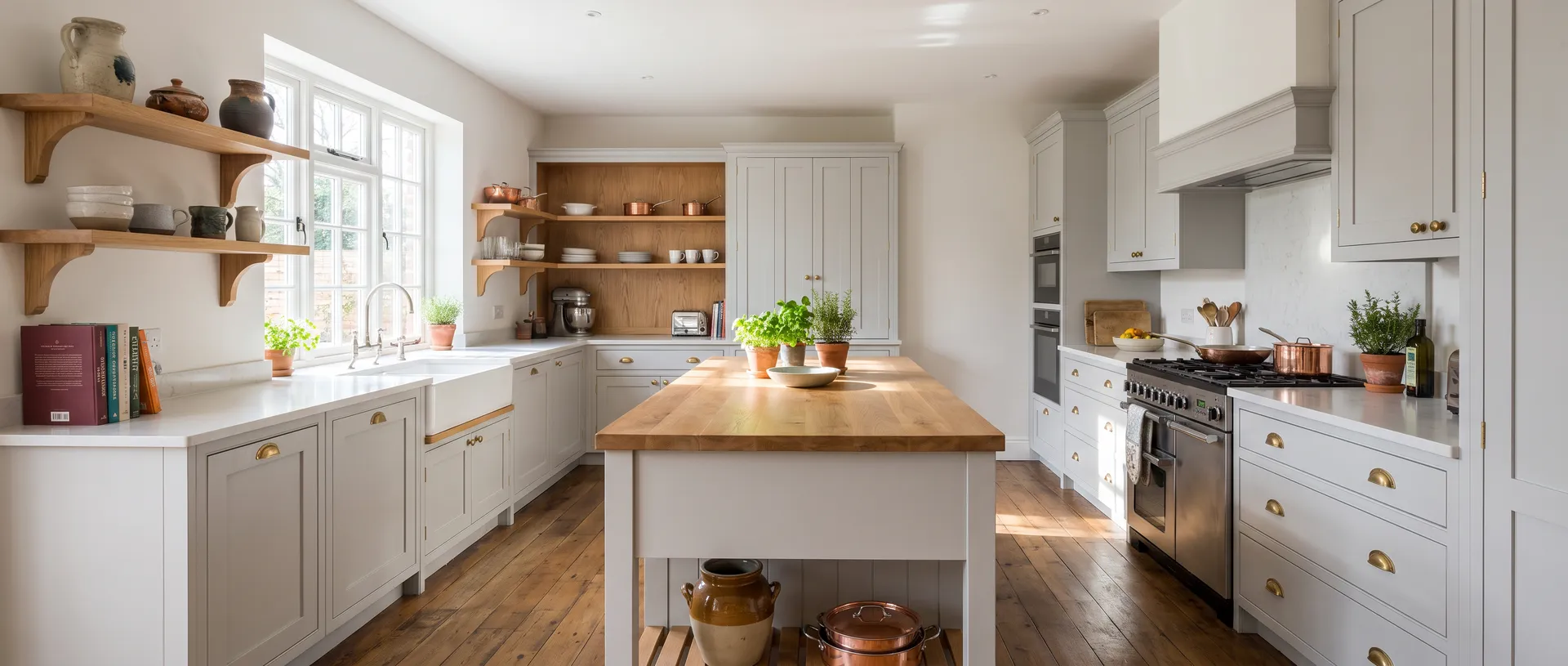
Appliance Fitting Cost — What Does Appliance Installation Cost?
Fitting integrated appliances into their housing cabinets is included in our kitchen installation rate. Electrical connections (ovens, hobs, extractors) require a qualified electrician, and plumbing connections (dishwasher, sink waste) require a qualified plumber — these are separate costs you arrange directly.
- Fitting integrated appliances into their cabinet apertures is included in our kitchen installation rate — no separate charge per appliance.
- Electrical connections (ovens, hobs, extractors) must be made by a qualified electrician — we do not carry out electrical work.
- Plumbing connections (dishwasher, washing machine, sink) must be made by a qualified plumber — we do not carry out plumbing work.
- We co-ordinate the sequence of trades to ensure electrician and plumber visits slot efficiently into the installation programme.
Integrated vs Freestanding Appliances — What Is the Difference for Fitting?
The main distinction for kitchen installation purposes is between integrated and freestanding appliances. Integrated appliances are built into the cabinet layout and fitted with a matching cabinet door so they blend seamlessly into the kitchen. Freestanding appliances stand independently and are simply positioned in a gap in the unit run.
Fitting an integrated appliance involves securing it within its housing cabinet, fitting the integrated door (which may be hinged at the top, bottom, or side depending on the appliance), adjusting the door so it aligns with the surrounding cabinets, and connecting any mechanical anti-tilt brackets or soft-close mechanisms. This work is included in our standard installation rate.
Freestanding appliances — a range cooker, a freestanding fridge-freezer, a washing machine — simply need positioning in their allocated space and levelling on adjustable feet. They do not require fitting into a cabinet. The electrical or gas connection is made by the relevant trade.
Appliance Fitting — What Is Involved for Each Type?
Different appliances have different fitting requirements. Here is what is involved for each common appliance type and who is responsible for each part of the installation.
-
Oven (single or double, integrated)
The oven housing cabinet is fitted as part of the unit installation. The oven itself is slid into the housing, secured with the fixing screws through the appliance frame into the cabinet sides, and the door is fitted and adjusted. Electrical connection — typically a 13A fused spur or a dedicated 30A or 45A circuit depending on the oven — is made by your electrician.
Cabinet fitting by us. Electrical connection by your electrician.
-
Hob (ceramic, induction, gas)
The hob cutout in the worktop is made by us for laminate worktops, or by the stone supplier for stone worktops. The hob is dropped into the cutout and secured with the supplied clips. For induction and ceramic hobs, the electrical connection (typically a dedicated 32A or 45A circuit) is made by your electrician. For gas hobs, the gas connection is made by a Gas Safe registered engineer.
Cutout and positioning by us. Electrical or gas connection by the relevant trade.
-
Extractor hood
The extractor is mounted to the wall or cabinet above the hob, at the correct height for effective extraction. Ducted extractors need a duct run to an external wall — this route is assessed at the pre-installation survey. Recirculating extractors use a charcoal filter and do not require external ducting. The electrical connection for the extractor is made by your electrician.
Mounting and duct connection by us. Electrical connection by your electrician.
-
Dishwasher (integrated or freestanding)
An integrated dishwasher is slid into its housing, secured with bracket fixings to prevent tipping, and fitted with an integrated door panel. The inlet and waste connections are made by your plumber. A freestanding dishwasher is simply positioned in its gap and levelled.
Cabinet fitting and door by us. Plumbing connections by your plumber.
-
Fridge and fridge-freezer (integrated)
Integrated fridges slot into a tall or under-counter housing cabinet. A full-height integrated fridge-freezer typically requires a hinged door mechanism (often a 70/30 split with a door-on-door hinge kit) that must be correctly assembled and adjusted. This is one of the more intricate appliance-fitting tasks. No electrical or plumbing connections are required for a standard fridge — simply plug into a socket.
Cabinet fitting and door mechanism by us. Plug-in electrical by you.
-
Wine cooler and warming drawer
Wine coolers are fitted in the same way as under-counter fridges. Warming drawers slot into a standard oven-height housing and are secured with fixing screws. Both require electrical connection by your electrician.
Cabinet fitting by us. Electrical connection by your electrician.
Arranging Your Electrician and Plumber
We work with your electrician and plumber rather than supplying them directly. This gives you full control over who does the electrical and plumbing work, and means you are not tied to a referral arrangement that may not suit your budget or schedule. Many of our customers have existing trades they trust; if you do not, we are happy to suggest local contacts.
The sequence of trades matters. For a typical kitchen installation, first-fix electrical work (moving or adding circuits, running cables) and first-fix plumbing (moving waste and supply positions) should be complete before the kitchen installation begins. Second-fix electrical (connecting the oven, hob, and extractor) and second-fix plumbing (connecting the sink and dishwasher) take place after the units and worktop are fitted.
At the pre-installation survey, we discuss the trade sequence with you and agree the likely second-fix dates so you can book your electrician and plumber accordingly. A well-sequenced project avoids the frustrating situation of a kitchen sitting without worktop connections because a trade is unavailable for two weeks after the units are in.
What Affects the Total Time for Appliance Fitting?
Most kitchens include 3–6 integrated appliances. Fitting each one adds time to the installation programme — typically 30 minutes to 2 hours per appliance depending on complexity. A single oven dropping into a straightforward housing takes far less time than a complex integrated fridge-freezer with a custom door-on-door mechanism that requires careful adjustment to align with the surrounding doors.
Extractor fitting time depends primarily on whether the installation is ducted or recirculating, and whether an existing duct run can be reused. A recirculating extractor with no duct is straightforward. A ducted extractor requiring a new run through an external wall involves additional work and is assessed at the pre-installation survey.
The number and type of integrated appliances in your kitchen will always be noted at the pre-installation survey and factored into your fixed-price quote. There are no additions for appliance fitting beyond what is agreed at survey stage.
Frequently Asked Questions
Yes. Physically fitting integrated appliances into their cabinet apertures — securing the appliance, fitting the door, and connecting any mechanical fixings — is included in our kitchen installation rate. Electrical and plumbing connections are made by your electrician and plumber.
Yes. All electrical connections — oven circuits, hob connections, extractor wiring, and socket additions — must be made by a qualified electrician. This is a legal requirement under Part P of the Building Regulations. We can advise on the sequence so your electrician's visits fit efficiently around the installation.
Yes. The dishwasher must be connected to the water supply and waste by a qualified plumber. We position and secure the dishwasher in its housing and make the cabinet door connection, but the water connections are made by your plumber.
We can position a freestanding cooker or range in its allocated space and ensure it sits level, but the gas or electrical connection must be made by a Gas Safe registered engineer or a qualified electrician respectively. Freestanding appliances do not require fitting into a cabinet, so they add less time to the installation than integrated appliances.
Related Pages
- Worktop Fitting Cost Laminate, quartz and granite worktop fitting prices.
- Kitchen Survey Cost What the £195 pre-installation survey covers.
- Kitchen Fitting Labour Cost Day rates and labour pricing explained.
- Kitchen Fitting Labour Cost Day rates and what affects total labour cost
- Worktop Fitting Cost Laminate, stone, and standalone worktop replacement
- Kitchen Installation Cost Guide Full breakdown of installation costs and typical ranges
- Book a Survey Get a fixed-price quote with our £195 pre-installation survey
- Our Services Everything we fit and how we work
- Contact Us Get in touch with Install My Kitchen
Get a Fixed-Price Quote Including All Your Appliances
Book a pre-installation survey and we will assess every appliance in your plan, confirm what we fit and what your trades connect, and give you a fixed price for the full installation.