
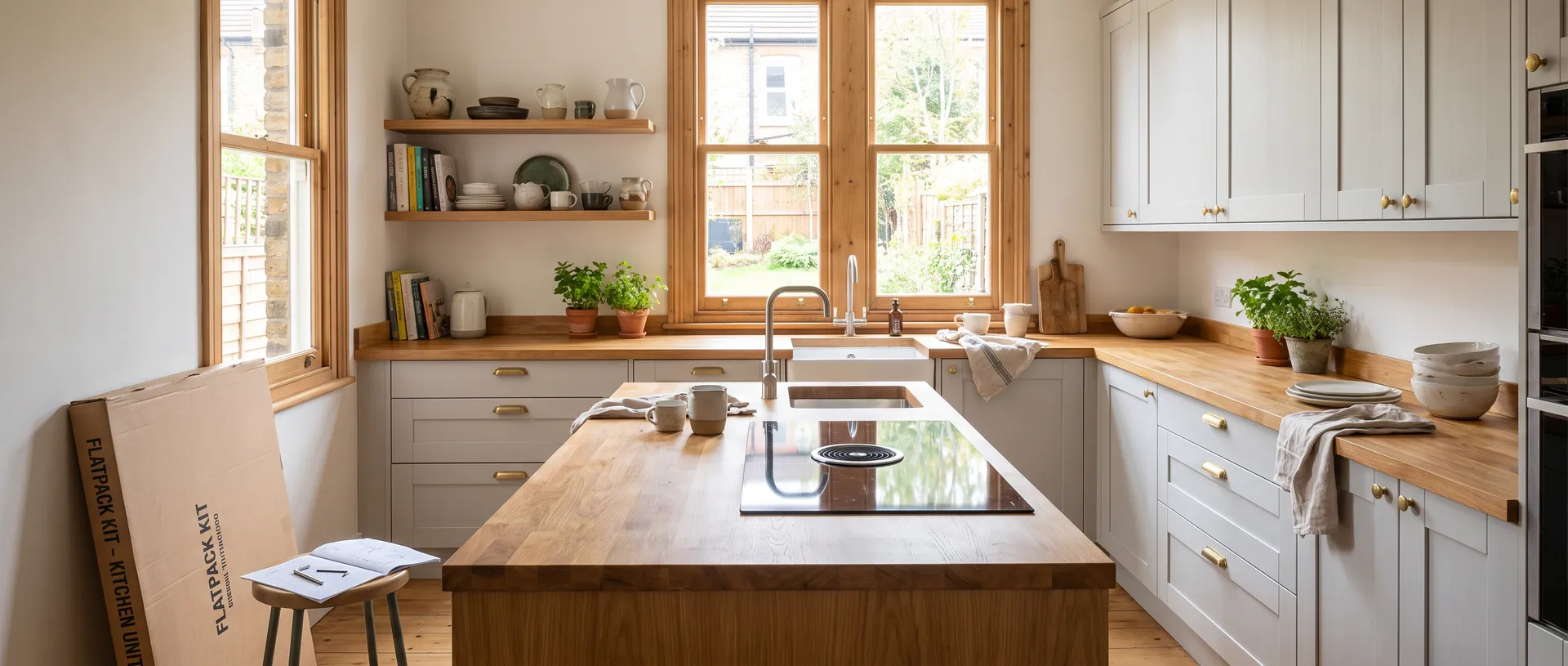
What Is the Difference Between Rigid and Flatpack Kitchens?
Rigid kitchens arrive with carcasses pre-assembled; flatpack kitchens arrive in flat panels that are assembled on site. Rigid kitchens typically install faster; flatpack gives more flexibility in tight access situations.
Rigid Kitchens
Rigid (or pre-assembled) kitchen units arrive with the carcass already built. Brands like Wren, Howdens and Magnet supply rigid units. Installation is typically faster as the fitter does not need to assemble the box before fixing it. Rigid units are generally considered more structurally stable in the long term.
Flatpack Kitchens
Flatpack kitchens — most notably IKEA — arrive as flat panels that are assembled by the kitchen fitter. This takes longer but can be advantageous where access is limited (narrow doorways, tight staircases) as each panel is smaller and easier to move. The finished result, when assembled correctly, is structurally sound.
Which Is Better?
- Rigid units are faster to install and are the standard in the UK kitchen market
- Flatpack units may be preferable where access is very restricted
- Both types, when installed by a skilled fitter, produce excellent results
Rigid vs Flatpack at a Glance
| Rigid | Flatpack | |
|---|---|---|
| Arrives as | Pre-built carcass | Flat panels for on-site assembly |
| Typical brands | Wren, Howdens, Magnet, Symphony | IKEA, some budget ranges |
| Access through tight doorways/stairs | Can be difficult — carcasses are bulky | Easier — panels are slim until assembled |
| Installation time | Faster per unit | Slower — assembly adds time |
| Long-term structural rigidity | Generally very good | Good, if assembled correctly and not repeatedly dismantled |
A Practical Access Consideration
If you live in a flat with a narrow stairwell or a period property with tight internal doorways, ask your fitter to check carcass dimensions against your access points before ordering a rigid kitchen — some larger rigid units simply will not go round tight corners and may need to be ordered flatpack even if the rest of the kitchen is rigid.
Can You Mix Rigid and Flatpack in One Kitchen?
Yes. It's common for the bulk of a kitchen to be rigid while one or two awkward-to-access units, such as an integrated fridge housing taken up a tight staircase, are ordered flatpack and built in place.
Related Questions
Not necessarily. While rigid kitchens can install faster, fitter rates are typically based on unit count and complexity rather than rigid vs flatpack.
Yes, IKEA's METOD range is a flatpack system assembled on site. Some other brands offer a mix of rigid and flatpack options.
Rigid units tend to be more robust structurally, but a well-assembled flatpack from a reputable brand like IKEA can last as long with proper care.
Related Questions
Explore More
- Book a Survey — £195 Credited back on booking. Carried out by our experienced fitting team.
- All Questions Answered 50 kitchen installation questions answered.
- Kitchen Installation Costs Full cost breakdown for Coventry, Warwickshire and Berkshire.
- About Pindi Sahota 30 years fitting kitchens across Coventry, Warwickshire and Berkshire.
Book a Survey With Pindi Sahota
Every survey conducted personally by Pindi. Fixed quote within 24 hours. £195 credited back on booking.