
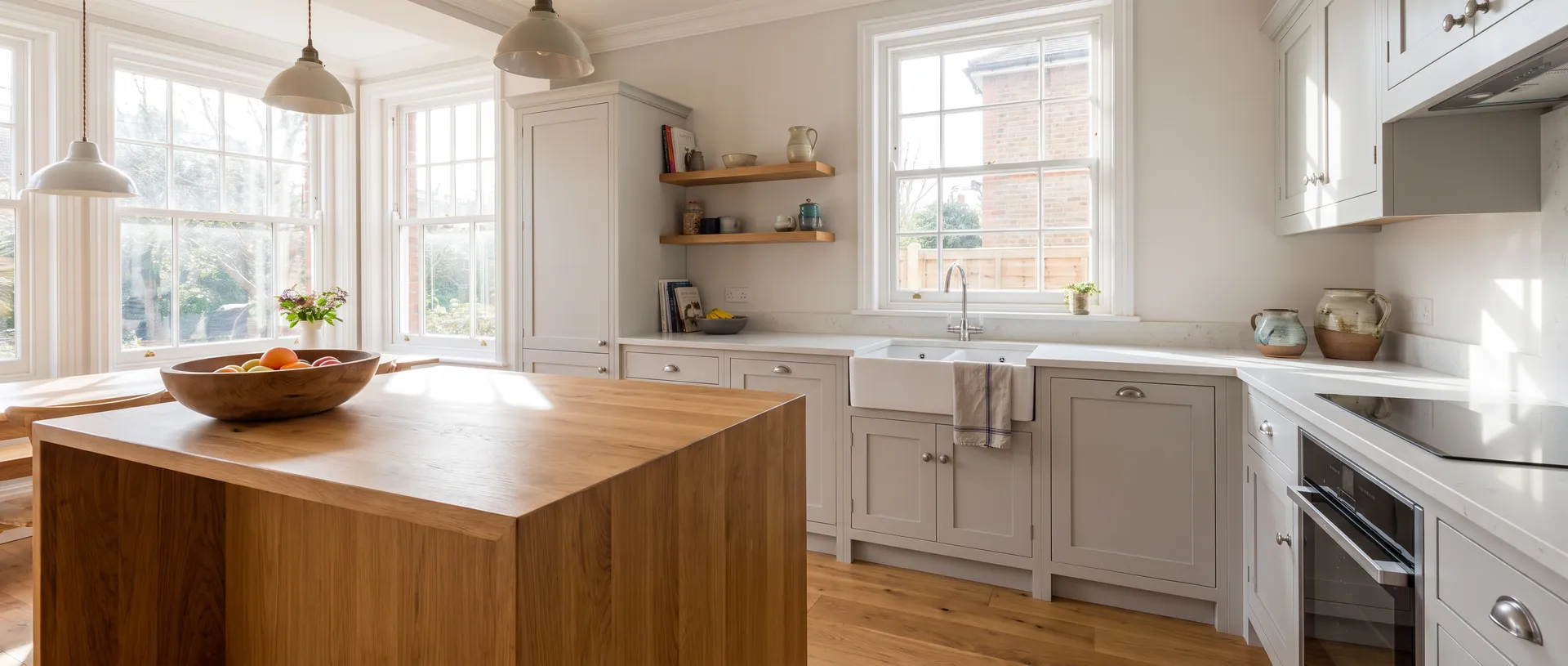
What Is a Quartz Worktop?
A quartz worktop is an engineered stone surface made from approximately 90% natural quartz crystals bound with resins and pigments. It is non-porous, extremely hard-wearing and available in a wide range of colours and finishes.
How Quartz Worktops Are Made
Engineered quartz worktops are manufactured by combining ground quartz with polymer resins under high pressure. The result is a dense, non-porous surface that does not need sealing. Pigments are added during manufacturing to achieve consistent colour, making engineered quartz more predictable in appearance than natural granite.
Key Advantages
- Non-porous — does not absorb liquids or stains
- No sealing required
- Consistent appearance (unlike natural stone where each slab is unique)
- Extremely hard-wearing and scratch resistant
- Hygienic and easy to clean
Limitations
- Not suitable for outdoor use — UV exposure causes fading
- Can be damaged by very high heat — use trivets or pan stands
- Heavier than laminate, requiring strong unit tops
- Cannot be cut on site — requires specialist templating and fabrication
Quartz vs Granite vs Laminate at a Glance
| Quartz | Granite | Laminate | |
|---|---|---|---|
| Porosity | Non-porous | Porous, needs sealing | Non-porous surface layer |
| Colour consistency | Very consistent | Unique per slab | Very consistent |
| Heat resistance | Good, avoid direct extreme heat | Very high | Moderate, use trivets |
| Cut on site? | No — factory cut from template | No — factory cut from template | Yes |
What Affects Quartz Cost Most
Beyond the base price per linear metre, the biggest cost variables are slab colour (some patterns cost significantly more than plain colours), edge profile complexity, and the number of joints required — a kitchen with an island typically needs at least one additional joint compared to a straightforward run.
Can Quartz Be Installed Over Existing Units?
Yes, provided the existing units are level, sound and structurally capable of bearing the additional weight of a stone worktop compared to whatever was fitted previously — this should always be checked before committing to a quartz upgrade on an older kitchen.
Related Questions
Quartz is generally more practical — it requires no sealing, has consistent colour and is non-porous. Granite is natural stone with unique character but requires periodic sealing.
Quartz worktops typically cost £300–£900 per linear metre installed, depending on brand, thickness, edge profile and complexity.
Minor chips can be repaired using a colour-matched epoxy resin filler. Deep chips or cracks may require professional repair or section replacement.
Related Questions
Explore More
- Book a Survey — £195 Credited back on booking. Carried out by our experienced fitting team.
- All Questions Answered 50 kitchen installation questions answered.
- Kitchen Installation Costs Full cost breakdown for Coventry, Warwickshire and Berkshire.
- About Pindi Sahota 30 years fitting kitchens across Coventry, Warwickshire and Berkshire.
Book a Survey With Pindi Sahota
Every survey conducted personally by Pindi. Fixed quote within 24 hours. £195 credited back on booking.