
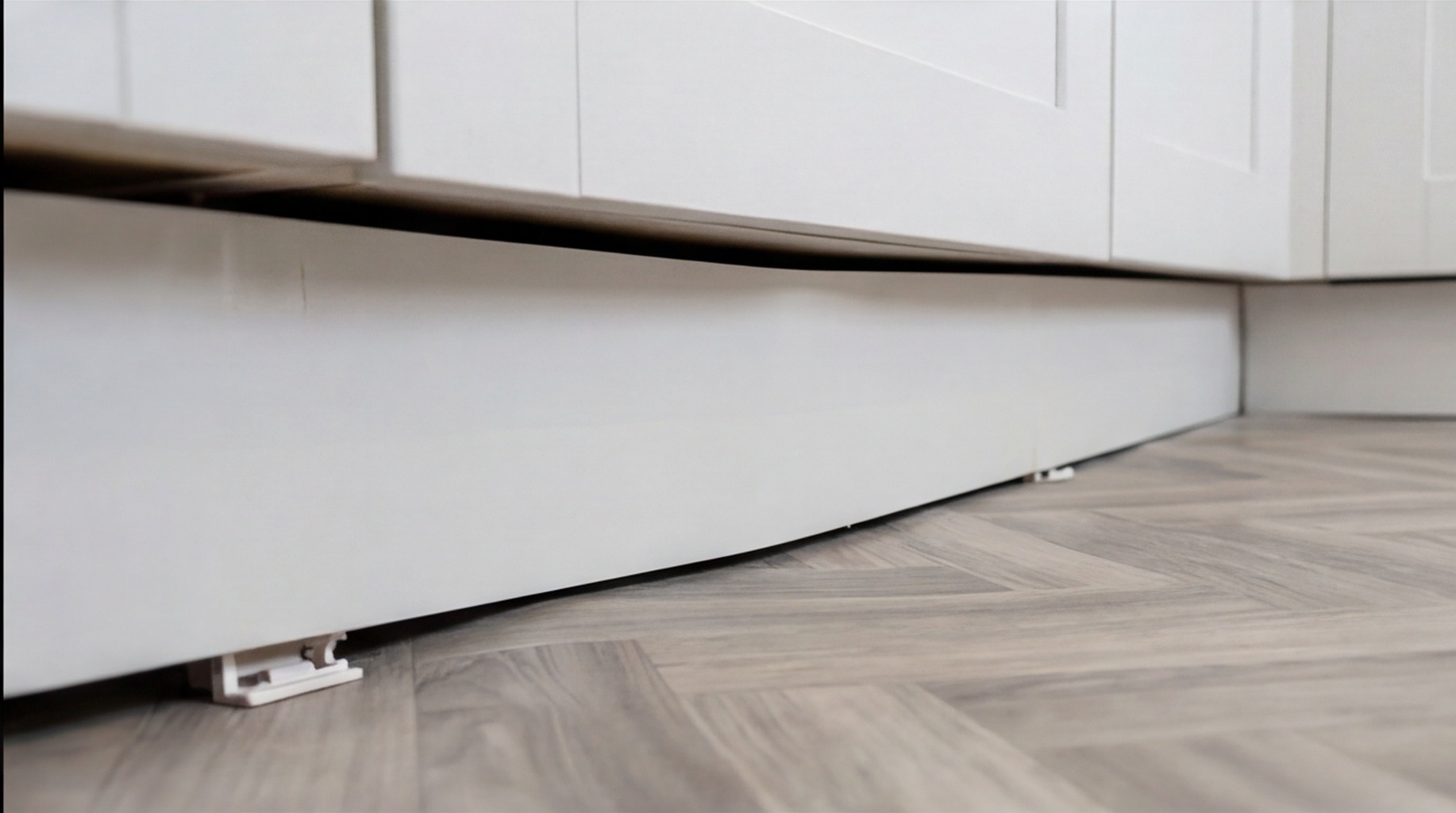
Kitchen Plinth Fitting Problems — Gaps, Buckling and Uneven Floors
Kitchen plinth problems — gaps at the floor, buckling, or plinths that pop off — are caused by uneven floors and incorrect clip installation. Correct solutions include scribing the plinth to follow the floor profile exactly, or using adjustable plinth clips that can be set to follow floor variations of up to 15 mm without cutting.
- Uneven floors are the primary cause of plinth gaps — the fix is scribing or adjustable clips, not forcing the plinth flat.
- Plinth clips must be fitted to the leg positions, not at random intervals, for a stable and removable fit.
- Scribed plinths are cut to follow the floor exactly — this technique is the most reliable for floors with significant variation.
The Problem
Plinths that don't sit flush against an uneven floor, or buckle after fitting, are a finishing issue that affects the overall appearance of the kitchen.
Plinths sit at the bottom of base unit runs, concealing the adjustable legs and closing the gap between the floor and the underside of the cabinets. On a perfectly flat floor, fitting plinths is straightforward. In reality, UK domestic floors — particularly in older properties — are rarely flat, and the plinth must accommodate whatever variation exists. A plinth simply pushed against an uneven floor will touch at its highest points and gap at its lowest, creating an untidy appearance and a path for dust and debris to accumulate beneath the units.
Buckling is a different problem and typically results from the plinth being fitted to clips that are not positioned correctly, or from the plinth material absorbing moisture and expanding slightly. Laminate plinth material is particularly susceptible: a small expansion in length will bow the face of the plinth outward if the clips do not allow any movement. In kitchens with underfloor heating, the thermal cycling of the floor can cause periodic expansion and contraction that loosens plinths over time if they are not correctly clipped.
The Solution
Plinths can be scribed to follow the floor contour or fitted with adjustable plinth clips that accommodate floor variation. Our installation includes all plinth fitting and adjustment.
The scribing method involves holding the plinth against the units in its installed position, then running a compass or scriber along the floor surface to transfer the floor contour onto the plinth face. The plinth is then cut along this scribed line with a jigsaw. When re-fitted, the cut edge follows the floor exactly and no gap is visible. The cut edge is typically hidden by the slight shadow at the junction with the floor, and if necessary a flexible silicone bead can be run along the base of the plinth to close any remaining gap.
Adjustable plinth clips are an alternative that avoids cutting. Each clip has a lower section that fixes to the adjustable leg and an upper section that grips the plinth. The lower section can be raised or lowered by a few millimetres to follow the floor contour. For floor variations of up to about 15 mm, this method produces a plinth that sits flush without scribing. For greater variation, scribing is more reliable. Our fitters assess the floor at the start of installation and choose the appropriate method for each run of units.
How a Survey Prevents This
Our £195 pre-installation survey measures floor levels across the entire kitchen footprint. Where floors are significantly uneven — more than 5 mm variation across a single run — the survey notes this and the installation quote accounts for additional scribing time. This means plinth fitting is never a last-minute improvisation: the fitter arrives prepared with the correct approach already planned.
To book your pre-installation survey, call Install My Kitchen on 07399 651836 or visit our survey page. We cover Coventry, the West Midlands and the surrounding area — survey appointments are typically available within two weeks.
Frequently Asked Questions
Yes — correctly fitted plinths should always be removable. Plinth clips are designed to allow the plinth to be pulled forward and removed without tools. If a plinth has been glued or nailed, access to the space beneath units for future plumbing or electrical work becomes very difficult. We always fit plinths with clips to allow easy removal.
A tiled floor is often slightly uneven at tile joints, and the transition between tile and wall can create a bump at the ends of the plinth run. Scribing to a tiled floor uses the same compass technique as scribing to a plain floor — the scribed line follows the tile surface profile. The plinth clip position may need to be adjusted to bring the plinth up to the tile level.
Plinth clips that repeatedly release usually indicate one of three things: the clips are not positioned at the leg locations (so the leg pushes the clip forward slightly when the plinth is pressed on), the plinth is slightly too long and bowing against the end wall, or the clip is the wrong type for the leg. Checking clip position against leg position resolves the first two issues; the third requires replacing the clips with the correct specification.
Explore More
- Kitchen Delivery Missing Parts — What to Do
- Kitchen Extractor Fan Installation Problems
- Kitchen Corner Unit Problems — Carousels, Magic Corners and Access
- Book a survey — avoid these problems £195 pre-installation survey — credited back on booking.
- 10 installation mistakes to avoid The most common kitchen installation mistakes and how to prevent them.
- Installation checklist Everything you need to prepare before your installation date.
- What is kitchen snagging? What snagging is and why it matters for a quality finish.
- Kitchen snagging guide Our complete guide to kitchen snagging and how we handle it.
- About Pindi — 30 years experience Meet your installer.
- Completed installations Real kitchens we have fitted across Coventry, Warwickshire and Berkshire.
- Cost guide Full breakdown of kitchen installation costs.
Book a Survey to Avoid Installation Problems
Our £195 pre-installation survey identifies issues before they happen — fixing floors, walls, deliveries and specification before your fitter arrives. Credited back in full when you proceed.