
Kitchen Snagging Guide
Snagging is the process of identifying and fixing minor defects after kitchen installation. Here is what to look for and how to handle it.
- Snagging should be done methodically — work through the kitchen section by section before sign-off.
- Common items include door alignment, drawer runners, plinths, silicone seals and handle positions.
- Distinguish between fitting defects (fitter's responsibility) and product defects (retailer's responsibility).
- Minor snagging items identified at handover are normal — a good fitter will resolve them promptly.
What Snagging Is
Snagging is the process of reviewing a completed installation for minor defects and ensuring they are put right before final sign-off. The term is borrowed from the house-building industry, where snagging lists are a standard part of the new-home handover process. In kitchen installation, snagging covers everything from a door that sits slightly out of alignment to a silicone bead that has been applied unevenly, or a plinth that does not sit flush with the floor.
Snagging items are, by definition, minor. They do not affect the structural integrity or safety of the kitchen. However, they are visible, and a kitchen that has not been properly snagged will have a less polished finish than one that has. A professional fitter views snagging as a normal and important part of the installation process, not as a sign that something has gone wrong.
Common Snagging Items
Door alignment is the most common snagging category. Individual doors must be hung with consistent gaps at top, bottom and sides. When the kitchen is complete, stand back and look at the door run from a slight angle — misalignment is often more visible this way than when looking straight on. Adjustment is made at the hinges, which on modern kitchen units allow three-dimensional movement (horizontal, vertical and depth).
Drawer fronts must be aligned with each other and with adjacent doors. Most drawer units use a separate front fixing that allows fine adjustment after the drawer is installed. Check that all drawer fronts are at the same height, that vertical gaps are consistent and that horizontal gaps match those of adjacent doors.
Drawer runners deserve individual attention. Open and close each drawer fully several times and check that it moves smoothly and returns to the closed position fully. A soft-close mechanism that does not engage, or a drawer that feels stiff or catches, indicates a problem with the runner adjustment or fitting.
Plinths (kick-boards) should sit flush to the floor and flush to adjacent plinths with no visible gaps. Where plinths are cut around uneven floors, the cut should be clean and the gap minimised. Check that all plinth clips are engaged and that plinths do not flex or rattle.
Handles should be fitted at consistent heights and angles across the entire kitchen. For horizontal bar handles on drawer fronts, all handles should be at the same height from the bottom of the front. For vertical handles on doors, all handles should be at the same distance from the edge and at the same height. Even a few millimetres of inconsistency is visible across a large door run.
Silicone seals at the junction between the worktop and walls, and around the sink, should be neat, continuous and correctly tooled. A poorly applied silicone bead is both unsightly and, in the case of the sink or worktop-wall junction, a potential source of water ingress. Check that the silicone is fully adhered and that there are no gaps or air bubbles.
Appliance functions should be tested during snagging. Open and close integrated appliance doors. Test dishwasher door springs. Check that extractor speeds are operational. Confirm that the oven and hob heat correctly (this can be done simply at snagging — a full cooking test comes with daily use).
How to Create a Snagging List
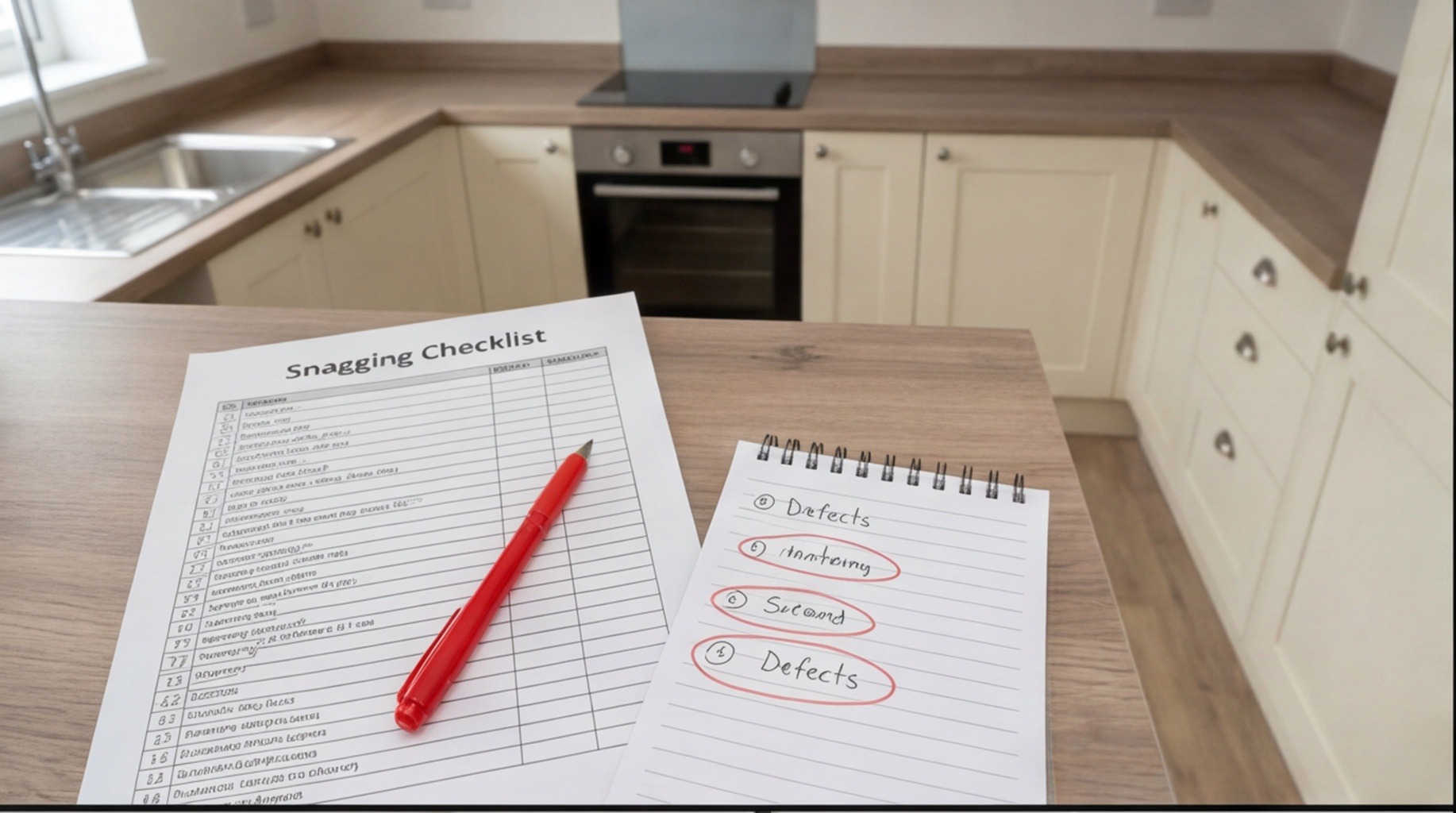
A snagging list is most effective when it is specific and systematic. Work through the kitchen in a logical sequence — for example, starting at one end of the base unit run and working along to the other end, then moving to wall units, then tall units, then appliances and finally the finishing details (plinths, silicone, lighting). For each item, note the specific location, the nature of the problem and, where possible, a photograph.
The more precise your description, the easier it is for the fitter to address efficiently. "Third base unit door from the left on the window wall — bottom left corner sits 4mm proud of adjacent door" is more useful than "some doors are misaligned". Share the list in writing — email or a messaging app with a written record — so there is no ambiguity about what was raised and when.
Fitting Defects vs Product Defects
It is important to distinguish between two categories of defect: those caused by the fitting (the fitter's responsibility) and those caused by the product (the retailer's or manufacturer's responsibility).
A fitting defect is something the fitter can correct — a door that was not correctly adjusted, a plinth that was cut inaccurately, a silicone bead that was applied carelessly. A product defect is a fault in the manufactured item — a door with a chip in the paint from the factory, a drawer box with a cracked runner, a unit carcass with a delaminating surface. Product defects are a matter between you and your retailer.
In practice, fitters will often help identify whether an issue is a fitting problem or a product problem, and may assist with communication to the retailer. However, they are not responsible for defects in products they did not manufacture.
How We Handle Snagging at Install My Kitchen
We carry out a snagging check as a standard part of every kitchen installation handover. Before we hand over, we walk through the kitchen systematically, identify any items that need attention and resolve them on the same day where possible. Items that require a return visit — for example, a replacement door that has been ordered from the retailer — are scheduled promptly and completed as soon as the relevant part is available.
We provide a 12-month workmanship warranty on all installations. If a fitting-related issue becomes apparent after handover within this period — a hinge that was not correctly torqued, a unit that has moved because a fixing point was inadequate — we will return and rectify it at no charge.
Living With the Kitchen: Post-Snagging Use
It is worth revisiting the kitchen after one to two weeks of normal use. Doors that felt fine during a walkthrough may reveal an issue once they are being opened and closed forty times a day. Drawer runners that sounded smooth during snagging may develop a slight catch under full loading. A second brief snagging check after the first week of use — noting anything that has emerged — gives your fitter a comprehensive picture and ensures the kitchen reaches its full potential.
Frequently Asked Questions
Walk through the kitchen systematically and note every item that is not right — use a notepad or your phone. For each item, note where it is (e.g. 'third drawer from the left on the base run'), what the problem is ('drawer front sits 3mm lower than adjacent drawer front') and, if possible, a photograph. Send the list to your fitter and agree a date for the snagging visit.
Most snagging is done at the end of the installation as part of the handover process. However, it is worth living with the kitchen for one to two weeks before doing a final snagging check — daily use reveals issues that are not obvious during a walkthrough inspection.
If the appliance has a manufacturing defect, the retailer or appliance manufacturer is responsible under the Consumer Rights Act 2015. If the appliance was installed incorrectly, the fitter is responsible. In practice, the fitter should help you identify the nature of the defect and liaise with the relevant party if needed.
Put your snagging list in writing (email is best) and set a reasonable deadline for response. If the fitter does not respond, follow up in writing again. If they remain unresponsive, contact your local Trading Standards office or, if you paid by credit card, consider a Section 75 claim against the card provider.
Related Guides
Related Pages
- Book a survey £195 pre-installation survey, credited back on booking.
- All kitchen installation questions Straight answers to every common question about kitchen fitting.
- Installation cost guide Transparent pricing and cost guides for kitchen fitting.
- Installation checklist Everything to prepare before your fitter arrives.
- 10 mistakes to avoid The most common kitchen installation errors — and how to sidestep them.
- Installation timeline Day-by-day guide to what happens during a kitchen installation.
- Completed kitchen projects Real installations in Coventry, Warwickshire and Berkshire.
- About Pindi Sahota 30 years of kitchen fitting experience — independent and local.
Ready to Get Your Kitchen Installed?
Book a pre-installation survey from £195 — credited back in full when you proceed. Covering Coventry, Warwickshire and surrounding areas.