
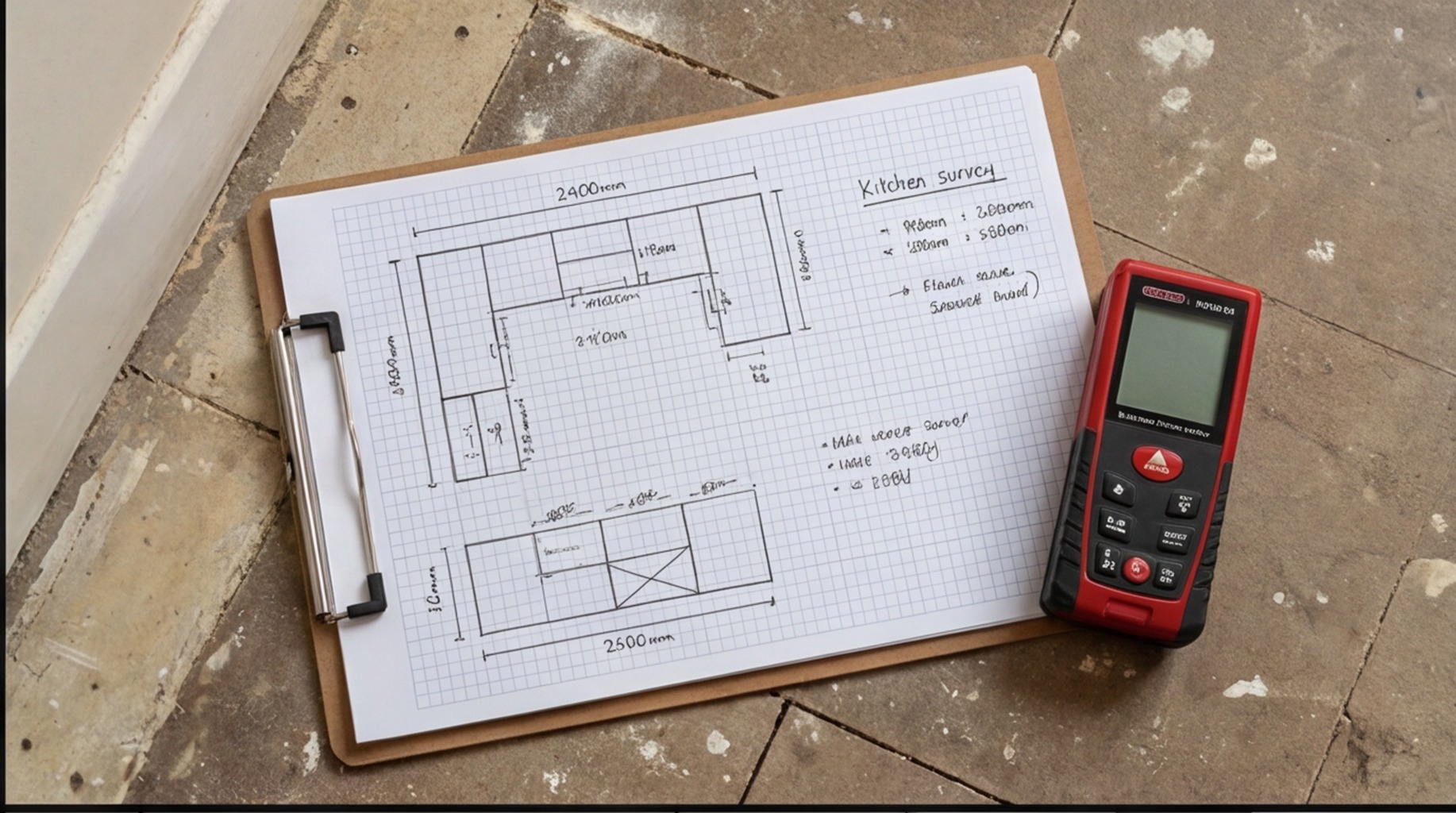
The Kitchen Installation Survey
A pre-installation survey is the most important step before your kitchen is fitted. Here is everything you need to know about the survey process.
- The survey identifies problems before installation — when they are cheap to fix, not after.
- The surveyor checks room dimensions against the kitchen plan, services, wall conditions and access.
- No reputable independent fitter should quote without surveying the room first.
- A survey fee credited back on booking is standard practice and a mark of a professional operation.
What a Pre-Installation Survey Is
A kitchen installation survey is a visit by an experienced fitter or surveyor to your home before any installation work begins. Its purpose is to identify discrepancies between the kitchen design and the actual room, assess the condition of services and structure, and plan the installation to avoid problems. It is, in short, the professional foundation that allows the installation itself to proceed efficiently.
The survey is distinct from the design consultation you may have had with your kitchen retailer. Retailers design kitchens based on measurements provided by the customer. Those measurements may be broadly accurate, but they rarely capture all the detail an experienced fitter needs — the exact position of a gas pipe, the degree to which a floor slopes, whether a wall is hollow or solid. The survey fills that gap.
What the Surveyor Checks: Room vs Plan
The first task is to compare the kitchen plan with the actual room. The surveyor will re-measure the space and check it against the retailer's design drawing. Discrepancies are common and often minor — a wall a centimetre shorter than recorded, a window slightly out of position. But they can also be significant enough to require adjustments to the plan before units are ordered.
The surveyor will check that all specified units will fit, that there is clearance for doors and drawers to open without obstruction, and that the layout allows safe and practical use. They will also confirm that appliance spaces match the appliance dimensions — a common source of error when customers specify appliances after the initial design.
What the Surveyor Checks: Services
Services — plumbing, gas and electrical — must be in the right positions for the kitchen to work as planned. The surveyor will locate the existing supply and waste connections, note their positions relative to the planned sink, dishwasher and appliances, and identify what first-fix work is required before the installation begins.
For gas, the surveyor will check the position of the existing gas supply relative to the planned hob or range cooker, and confirm whether a Gas Safe engineer will be required to move or extend the supply before installation day. For electrics, they will assess the existing circuit capacity and the position of sockets, and flag any work required by a Part P electrician.
What the Surveyor Checks: Walls, Floor and Access
Wall conditions matter significantly for kitchen installation. The surveyor will check whether walls are level and plumb, identify any areas of significant movement or unevenness that will need to be addressed, and assess whether walls are suitable for fixing wall units safely. A hollow plasterboard wall without adequate backing requires different fixings from a solid brick wall.
The floor level is equally important. Most homes have some floor variation — a drop from one end of the kitchen to the other is common. The surveyor will measure this and note how it will be managed with adjustable legs and plinths.
Access is often overlooked. The surveyor will assess how units will be brought into the property and whether there are any restricted doorways, staircases or tight corners that could cause problems on delivery or installation day.
What Can Go Wrong Without a Survey
Without a survey, problems are discovered during the installation itself — at the worst possible time. Units arrive that do not fit. The gas supply is in the wrong position and a Gas Safe engineer must be booked at short notice. A wall that was assumed solid turns out to be plasterboard, requiring the fitter to stop and source appropriate fixings. A floor variation means the plinth line is uneven and the whole base unit run needs re-levelling.
Every one of these problems causes delays. In a tightly sequenced installation, a day's delay on base units means a day's delay on worktop templating, which means a day's delay on worktop delivery. A week-long installation can easily become a two-week installation, with all the associated disruption and cost.
How the Survey Fee Works
Most professional independent fitters charge a survey fee. This is reasonable — a thorough survey takes an experienced person one to two hours on site plus travel time and report preparation. A fee also ensures that both parties are genuinely committed to the project: it filters out speculative enquiries and ensures the surveyor's time is used on serious jobs.
At Install My Kitchen, we charge £195 for the survey, which is credited back in full when you proceed with the installation. This means that, in effect, the survey costs you nothing if you go ahead — you are paying for the surveyor's time only if you decide not to proceed, which is a fair arrangement for both parties.
How to Prepare for Your Survey Visit
Have your kitchen plan printed or available on a device. If you have a product list from your retailer, bring that too. Make a note of any concerns you already have — an unusual wall, a sloping floor, an existing pipe you are unsure about — and raise them at the start of the visit.
Clear reasonable access to the kitchen and ensure all areas that need to be measured or assessed are accessible. If your existing kitchen is in place, this is fine — the surveyor is experienced at working around existing furniture.
Questions to Ask Your Surveyor
A survey visit is an opportunity to ask questions. Useful ones include: Are there any issues with the current plan that you would recommend changing? What first-fix work needs to be done before the installation begins? Are there any aspects of this installation that are likely to take longer or be more complex than usual? What is your process if a problem is discovered during the installation itself?
The answers will give you a clear sense of the fitter's experience and the level of care they bring to the project. A surveyor who answers these questions clearly and thoroughly is demonstrating exactly the kind of professionalism you want on site.
Frequently Asked Questions
A thorough survey typically takes 45 minutes to one and a half hours, depending on the complexity of the kitchen. Larger kitchens with multiple appliances, unusual layouts or known structural issues may take longer.
Have your kitchen plan (from the retailer), the full product list, and any drawings or measurements you have. If you know of any existing issues — a floor that is not level, a wall that is not square — mention them at the start. The more information the surveyor has, the more accurate and useful the survey will be.
A survey significantly reduces the risk of surprises, but it cannot guarantee that no issues will arise during the job. Hidden structural elements, concealed pipes or cables, and problems revealed only when the old kitchen is removed can all emerge during installation. A good fitter will communicate these clearly and discuss solutions as they arise.
Survey fees are generally non-refundable if you decide not to proceed — they cover the surveyor's time, travel and expertise. However, many independent fitters, including Install My Kitchen, credit the full fee against the installation cost if you do proceed.
Related Guides
Related Pages
- Book a survey £195 pre-installation survey, credited back on booking.
- All kitchen installation questions Straight answers to every common question about kitchen fitting.
- Installation cost guide Transparent pricing and cost guides for kitchen fitting.
- Installation checklist Everything to prepare before your fitter arrives.
- 10 mistakes to avoid The most common kitchen installation errors — and how to sidestep them.
- Installation timeline Day-by-day guide to what happens during a kitchen installation.
- Completed kitchen projects Real installations in Coventry, Warwickshire and Berkshire.
- About Pindi Sahota 30 years of kitchen fitting experience — independent and local.
Ready to Get Your Kitchen Installed?
Book a pre-installation survey from £195 — credited back in full when you proceed. Covering Coventry, Warwickshire and surrounding areas.