
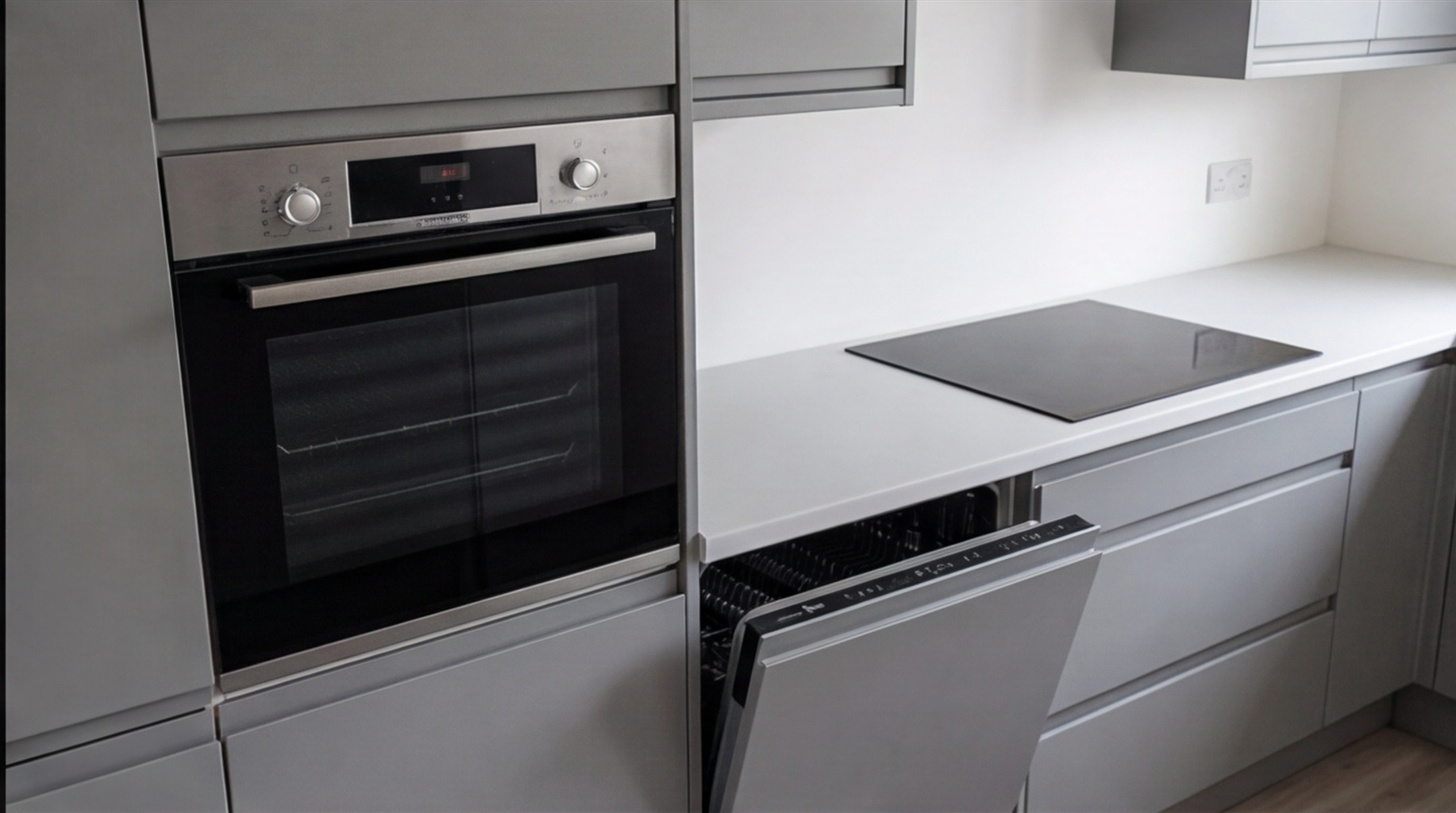
Kitchen Appliance Installation Guide
Built-in kitchen appliances require careful installation. Here is how to ensure your appliances are fitted correctly and safely.
- Hardwired appliances (ovens, hobs) must be connected by a Part P registered electrician — not the kitchen fitter.
- Dishwashers and washing machines require a plumber for water supply and waste connections.
- Extractor hoods should be installed before wall units above them are finally fixed in position.
- Plan appliance installation as part of the overall fitting sequence — not as an afterthought.
Built-In Appliances: An Overview
Modern kitchens typically include a range of built-in appliances — ovens, hobs, extractor hoods, dishwashers, integrated fridges and freezers, washing machines and wine coolers. Each of these appliances has specific installation requirements, and several require work by qualified tradespeople that falls outside the scope of the kitchen fitter. Understanding which appliances need what — and when — is essential for planning a smooth installation.
Types of Built-In Appliances
Built-in appliances fall into two broad categories: those that slot into a housing unit (built-under ovens, integrated dishwashers, integrated fridge-freezers, wine coolers) and those that are integrated into the worktop or wall unit area (hobs, extractor hoods). Each has different installation requirements and fits at a different stage of the overall sequence.
Appliances also differ by connection type: electrical (requiring a certified electrician if hardwired), plumbed (requiring a plumber), or simply plug-in (which the kitchen fitter can handle).
Ovens and Range Cookers
Single built-under ovens are usually connected via a 13-amp plug if they are under 3kW and may be plugged in by the fitter once the housing unit is in position. Double ovens and larger single ovens are typically hardwired and must be connected by a Part P registered electrician. Range cookers are always hardwired — and if gas-fuelled, also require a Gas Safe registered engineer for the gas connection.
The oven housing unit must be at the correct height in the tower or tall unit run. The fitter will position and fix the oven, but the electrical connection should be scheduled with your electrician for the second-fix stage, once the unit is in place.
Hobs
Electric hobs (induction and ceramic) are hardwired and require a dedicated 32-amp or 45-amp circuit installed by a Part P electrician. This circuit must be in place as part of the first-fix electrical work, before units are installed. Gas hobs require a Gas Safe engineer to connect the gas supply.
The hob is fitted into a cut-out in the worktop. For laminate worktops, the cut-out is made on site by the fitter. For stone worktops, the hob cut-out is templated and cut by the stone fabricator before delivery. Confirm the hob dimensions with your worktop supplier before templating.
Extractor Hoods
Extractor hoods come in ducted (external vent) or recirculating (filter) configurations. Ducted extractors must be connected to an external vent — either through the wall or up through the ceiling and out through the roof. The ducting route should be agreed before installation begins.
The extractor should be installed during the wall unit stage so that ducting can be positioned and hidden behind cabinetry. Installing the extractor after wall units are fully fixed makes ducting awkward and may require revisiting units that are already in place.
Electrically, most extractors are 13-amp plug-in appliances and can be connected by the fitter. Confirm this for your specific model before assuming.
Dishwashers and Washing Machines
Dishwashers and washing machines require a water supply, a hot or cold fill connection and a waste connection. These connections must be made by a plumber. The first-fix work — running the supply and waste pipes to the appliance location — should be completed before units are installed. Second-fix connections (actually connecting the appliance to the pipes) are made once the appliance is in its housing unit, typically near the end of the installation.
Integrated dishwashers are fitted with a full-height door panel that matches the kitchen door style. The door is hung on the dishwasher using a door-on-door kit, and careful alignment with adjacent doors is part of the fitter's snagging process.
Integrated Fridge-Freezers
Integrated fridge-freezers require a housing unit that matches the appliance dimensions exactly. The appliance is fitted into the unit and connected via a door mechanism — either door-on-door or hinge-on-hinge — that transfers the door from the cabinet to the appliance as you open and close it. This mechanism must be carefully calibrated to allow the fridge door to open fully without obstruction.
A freestanding fridge-freezer placed in an integrated housing is not a substitute — the appliance must be specifically designed as an integrated model, with the correct dimensions and hinge arrangement for the mechanism to work.
How We Co-Ordinate Appliance Installation
At Install My Kitchen we sequence appliance installation to align with each appliance's position in the fitting process. Extractors are fitted during the wall unit stage. Oven housings are prepared during the tower unit stage with connections scheduled with the electrician. Hobs are co-ordinated with the worktop — either cut on site for laminate or confirmed with the stone supplier for stone worktops. Dishwasher and fridge connections are scheduled with the plumber for the second-fix stage. This sequencing prevents work having to be undone and redone, and keeps the installation on schedule.
Frequently Asked Questions
It depends. Plug-in ovens (those with a standard 13-amp plug) can be connected by the kitchen fitter. Hardwired double ovens and range cookers require connection by a Part P registered electrician. Confirm the connection type for your specific appliance before installation day.
The extractor should ideally be installed during the wall unit stage, before the units directly above it are finally fixed. This allows ducting to be routed and fixed without having to work around completed cabinetry. If you are fitting a recirculating extractor (no external duct), timing is more flexible.
Yes. Integrated fridge-freezers are fitted behind a cabinet door using a door-on-door or hinge-on-hinge mechanism. The housing unit dimensions must exactly match the appliance dimensions, and the door alignment must be carefully set. This is part of the fitter's scope, but it takes more time than a standard cabinet.
If the appliance was delivered damaged, the retailer or supplier is responsible. If it was damaged during installation, the fitter is responsible. Document the condition of all appliances before they are positioned and keep records of any damage found on delivery.
Related Guides
Related Pages
- Book a survey £195 pre-installation survey, credited back on booking.
- All kitchen installation questions Straight answers to every common question about kitchen fitting.
- Installation cost guide Transparent pricing and cost guides for kitchen fitting.
- Installation checklist Everything to prepare before your fitter arrives.
- 10 mistakes to avoid The most common kitchen installation errors — and how to sidestep them.
- Installation timeline Day-by-day guide to what happens during a kitchen installation.
- Completed kitchen projects Real installations in Coventry, Warwickshire and Berkshire.
- About Pindi Sahota 30 years of kitchen fitting experience — independent and local.
Ready to Get Your Kitchen Installed?
Book a pre-installation survey from £195 — credited back in full when you proceed. Covering Coventry, Warwickshire and surrounding areas.