
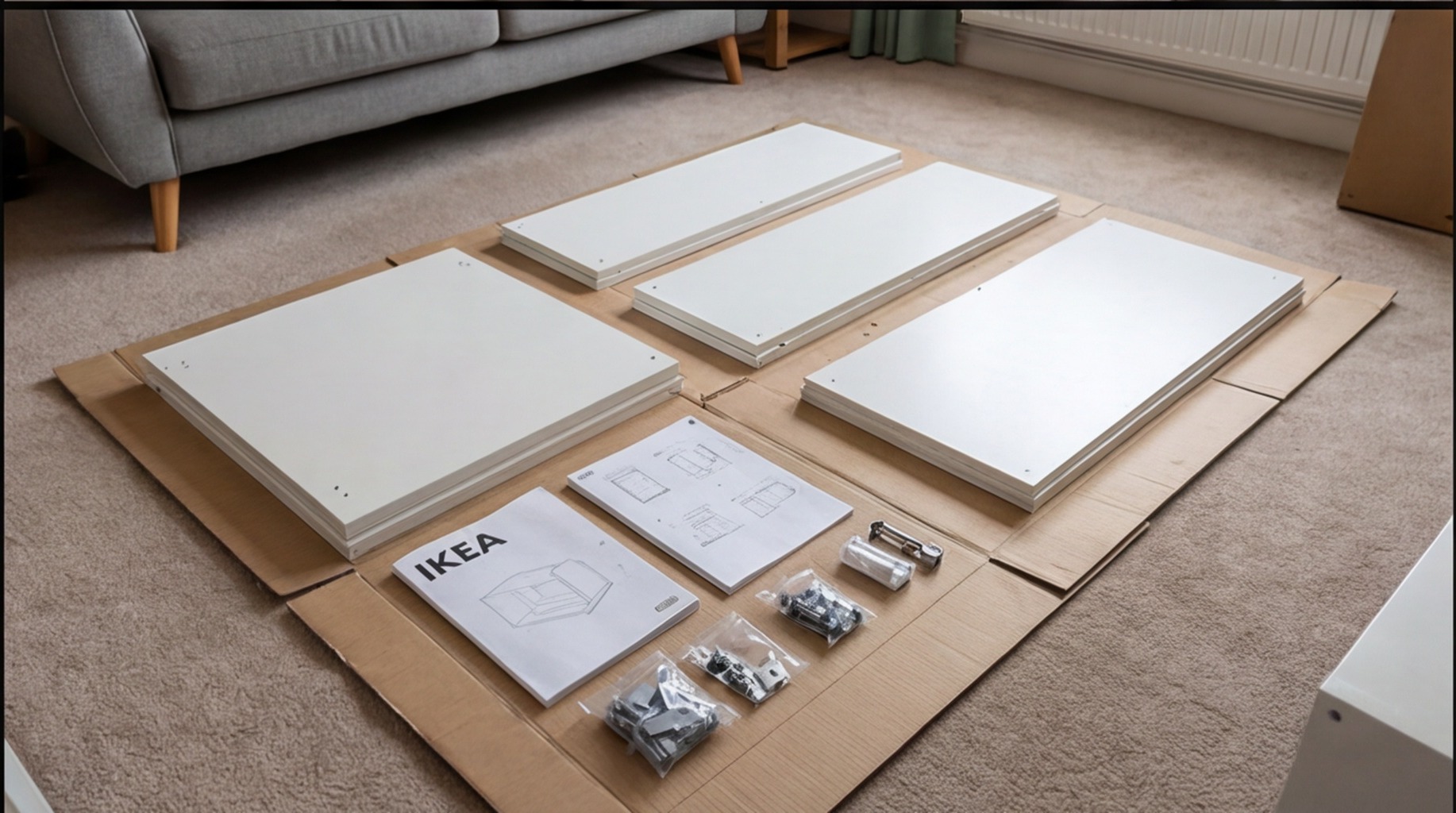
IKEA Kitchen Installation Guide
IKEA kitchens are one of the most popular choices in the UK and can be installed by an independent fitter. Here is what you need to know about the process.
- IKEA METOD is a flat-pack system — all units are assembled on site, which adds time versus rigid construction.
- Check your IKEA delivery carefully — missing parts can be ordered individually, but this takes time.
- Corner units, pull-outs, carousels and deep drawers take significantly longer to fit and adjust than basic carcasses.
- An experienced independent fitter is fully capable of fitting an IKEA kitchen to an excellent standard.
Why IKEA Kitchens Are Popular
IKEA kitchens — sold under the METOD system — offer good design variety at an accessible price point. The modular system allows considerable flexibility in layout and configuration, and the range of door styles (sold separately under names such as AXSTAD, VOXTORP, BODBYN and KUNGSBACKA) covers everything from contemporary gloss to traditional Shaker. IKEA also sells a comprehensive range of accessories, internal organisers, sinks and taps that integrate with the METOD carcass.
The flat-pack format means the entire kitchen can be delivered in boxes and assembled on site. This has practical advantages — boxes can be carried through a narrow hallway or up a staircase — but it adds time to the installation compared with pre-assembled rigid units.
Disclaimer: Install My Kitchen is an independent fitting company with no commercial affiliation to IKEA. Our knowledge of the METOD system is based entirely on our practical installation experience.
The IKEA METOD System
METOD carcasses come in standard widths (20cm to 80cm) and heights (40cm to 80cm for base units; 40cm to 100cm for wall units; 140cm to 220cm for tall units). Each carcass is flat-packed with pre-drilled holes and cam-lock fittings for assembly. The carcass material is a melamine-faced particleboard, which is robust when properly assembled but requires careful handling during the build.
Wall units in the METOD system are hung from a continuous wall rail, rather than being individually fixed to the wall. The rail is fixed first, and units then hook onto it and are adjusted for height and level. This is a well-engineered system that allows fine adjustment without re-drilling, but the rail must be fixed correctly to a solid wall or into adequate backing in a hollow wall.
Drawer fronts and door panels are sold separately and clip onto standard runners and hinges. The separation of carcass and front allows considerable flexibility in updating the kitchen's appearance without replacing the structure.
The Assembly Process
IKEA unit assembly is the most time-consuming aspect of an IKEA kitchen installation compared to a rigid-construction kitchen. Each carcass must be assembled from the flat pack before it can be positioned and levelled. For a kitchen of 15 carcasses, this assembly stage alone takes a significant portion of the first day.
An experienced fitter will develop an efficient assembly sequence — building similar units in batches, pre-fitting hinges before positioning, and staging assembled units in an order that minimises handling. A fitter unfamiliar with IKEA's system will take considerably longer and may make assembly errors that need to be undone and redone.
When comparing quotes for IKEA kitchen fitting, be cautious of very low prices — they may not account properly for the time IKEA assembly requires.
What Takes Longer: Corner Units, Pull-Outs and Deep Drawers
Standard base and wall carcasses, once assembled, fit in a broadly predictable time. However, certain IKEA units are significantly more time-consuming. Corner base units (especially those with UTRUSTA or MAXIMERA carousel mechanisms) require careful fitting and adjustment of the mechanism. METOD-style pull-out inserts for base units must be fitted and aligned carefully. Deep drawer units with MAXIMERA drawer boxes require precise adjustment of each drawer front for level and gap consistency.
When planning the timeline for an IKEA kitchen installation, account for these elements. A kitchen with six corner units and multiple pull-out base units will take meaningfully longer than one with the same number of standard carcasses.
Checking Your IKEA Delivery
IKEA deliveries for a full kitchen can comprise many boxes. Check each box against your picking list (the document IKEA provides listing every item in your order) as soon as the delivery arrives. Common missing or incorrect items include: door and drawer fronts (which can look similar but come in different sizes); individual hardware packs (hinges, screws, cam locks); specific accessory kits such as drawer inserts; and plinths.
Missing parts can be ordered directly from IKEA's website or obtained from a store. Most standard hardware items are available relatively quickly. Missing carcasses or fronts may take longer. Raise any issues as soon as possible — do not wait until installation day.
Typical Timeline for an IKEA Kitchen
For a medium kitchen of 12 to 18 carcasses with a standard layout, expect four to six working days for an experienced fitter. Day one will typically cover delivery check, assembly of base carcasses and initial positioning. Days two and three cover wall units, tall units and any specialist units. Days three to four cover worktops (cut on site for laminate, or the start of the stone templating wait). Days four to six cover doors, drawer fronts, handles, plinths, appliances and snagging. Second-fix plumbing and electrical work by the relevant trades completes the installation.
If you have a worktop templating and delivery gap (typical for stone worktops), the overall project may span ten to fourteen working days from start to full completion, with the kitchen usable towards the end of this period.
Frequently Asked Questions
A medium IKEA kitchen (around 10 to 15 units) typically takes four to six working days for an experienced fitter. IKEA flat-pack assembly adds time compared to rigid units. Kitchens with complex layouts, many corner units or pull-out systems may take longer.
METOD is the current IKEA kitchen system, introduced in the UK in 2013. It replaced the earlier AKURUM system. METOD uses a wall-rail fixing system for wall units (rather than individual wall fixings) and a slightly different carcass construction. All current IKEA kitchens in the UK use the METOD system.
Yes. IKEA sells spare parts for METOD through its website and stores, including individual hinges, drawer runners, legs, rails and fixings. Major components such as unit carcasses can also be ordered. Lead times vary — in-store items are available immediately; special orders may take a week or more.
Yes, IKEA offers an installation service through third-party contractors. As with other retailers, you are not obliged to use it. Many homeowners choose an independent fitter for reasons of preference, cost or availability.
Related Guides
Related Pages
- Book a survey £195 pre-installation survey, credited back on booking.
- All kitchen installation questions Straight answers to every common question about kitchen fitting.
- Installation cost guide Transparent pricing and cost guides for kitchen fitting.
- Installation checklist Everything to prepare before your fitter arrives.
- 10 mistakes to avoid The most common kitchen installation errors — and how to sidestep them.
- Installation timeline Day-by-day guide to what happens during a kitchen installation.
- Completed kitchen projects Real installations in Coventry, Warwickshire and Berkshire.
- About Pindi Sahota 30 years of kitchen fitting experience — independent and local.
Ready to Get Your Kitchen Installed?
Book a pre-installation survey from £195 — credited back in full when you proceed. Covering Coventry, Warwickshire and surrounding areas.