
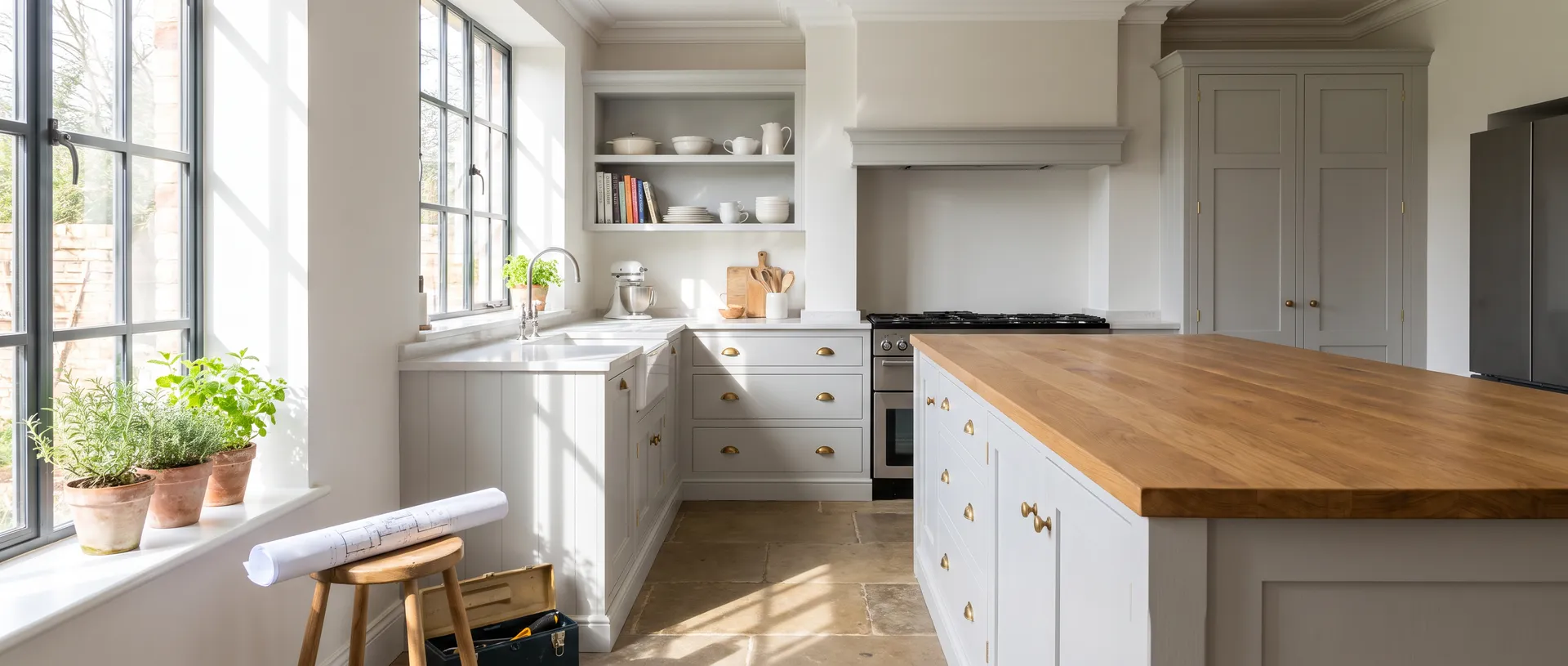
In-Frame vs Shaker Kitchen — Which Is Harder to Install?
In-frame kitchens are significantly more complex to install than shaker kitchens. The solid timber frame requires precise scribing, exact door-to-frame gap consistency, and careful levelling. In-frame installations typically take 20–30% longer and demand higher skill levels.
What Makes In-Frame Construction Different
A shaker kitchen has a simple construction — the door sits on the face of the cabinet carcass, attached by adjustable hinges. An in-frame kitchen is fundamentally different. Each cabinet has a solid timber or MDF frame fixed to the front of the carcass, and the door sits within this frame rather than over it. The result is a furniture-like appearance with visible frame reveals around each door — but achieving that appearance requires a level of precision that shaker installations simply do not demand. The frame must be square, level, and perfectly aligned, and the doors must be hung with entirely consistent gaps on all four sides.
Why In-Frame Takes Longer
The complexity of in-frame installation lies in several additional steps. The frame components must be cut, mitred, and assembled before doors can be hung. Any variation in the frame — even a millimetre — is clearly visible in the door-to-frame gap. Scribing an in-frame kitchen to an uneven wall requires removing material from the frame itself, which must be done carefully to avoid weakening it. Adjustable hinges are not always used in in-frame construction; some manufacturers use traditional butt hinges that have no adjustment, making precise positioning even more critical. These factors together add 20–30% to the installation time compared to an equivalent shaker kitchen.
Choosing the Right Fitter for In-Frame
In-frame kitchens should only be installed by experienced kitchen fitters with a proven record of in-frame work. Ask to see completed examples before committing. At Install My Kitchen, Pindi Sahota has installed in-frame kitchens across Coventry and Warwickshire throughout his 30-year career and understands the additional care and time that genuine in-frame construction demands. If you are investing in an in-frame kitchen, it is worth taking extra care in choosing the right installer — the quality of the installation determines whether the kitchen lives up to its premium appearance.
Cost Implications of In-Frame Installation
The additional 20–30% installation time for in-frame kitchens translates directly into additional labour cost. Where a medium shaker kitchen might cost £2,800–£4,200 to install, an equivalent in-frame kitchen typically costs 20–30% more due to the additional scribing, frame assembly, and door calibration time involved. This should be factored into your budget alongside the higher unit cost of in-frame cabinetry itself, which is generally a premium product line from any retailer offering it.
Common Problems During In-Frame Fitting
The most common issue during in-frame installation is inconsistent door-to-frame gaps, which become visible the moment natural light falls across the kitchen. This is usually caused by a frame that was not perfectly square when fixed, or hinges that were not given enough adjustment range to correct minor discrepancies. Another common issue is timber movement — solid timber frames can expand and contract slightly with seasonal humidity changes, and gaps that look perfect in summer may tighten slightly in winter. An experienced fitter allows a small, deliberate tolerance in the gap to accommodate this natural movement.
Related Questions
An in-frame kitchen provides a premium, furniture-like appearance that shaker construction cannot match. If the look is important to you and your budget allows, the additional cost of both the units and the installation is worthwhile for the finished result.
In theory yes, but in practice you should choose a fitter with specific in-frame experience. The tolerances are much tighter than shaker installation, and mistakes are difficult to correct without damaging the frame.
Yes — shaker kitchens are more forgiving than in-frame. Adjustable hinges allow door alignment to be corrected after fitting, and small gaps can be concealed by the door overlay. In-frame construction leaves nowhere to hide imprecision.
On an in-frame kitchen, you will see a solid frame surrounding each door, with a consistent reveal visible when the door is closed. On a shaker kitchen, the door sits flush against or slightly overlapping the cabinet front with no visible frame around the door.
Related Questions
Explore More
Ready to Book Your Kitchen Installation?
Book a survey and get a fixed quote within 24 hours. Survey fee £195 — credited back on booking.