
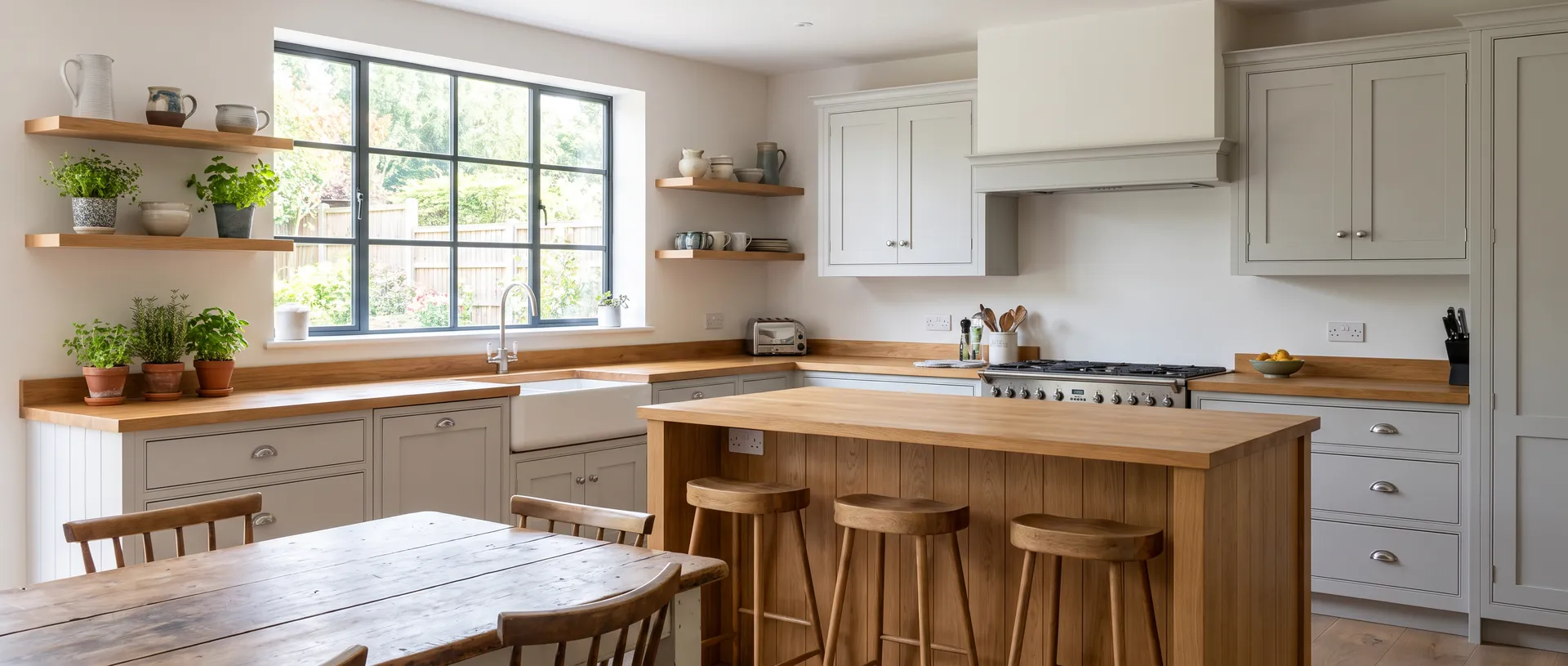
What Is a Kitchen Carcass?
A kitchen carcass is the structural box forming each cabinet — the sides, back, base, and top. Doors, drawers, and shelves attach to the carcass. Available in flat-pack (IKEA) or rigid pre-assembled (Wren, Howdens, Magnet). Carcass quality determines long-term structural integrity.
What a Carcass Is Made Of
A kitchen carcass is the structural box that forms the body of each kitchen cabinet. It consists of two side panels, a back panel, a base, and — on base units — a top rail. In most modern kitchens, carcasses are made from moisture-resistant (MR) chipboard or MDF with a melamine-faced interior. The thickness of the carcass panels varies between brands and price points — thicker panels (18mm or more) produce a more rigid, durable carcass than thinner economy alternatives. Doors, drawer fronts, shelves, and hinges all attach to the carcass.
Flat-Pack vs Rigid Pre-Assembled
Kitchen carcasses are supplied in two main forms. Flat-pack carcasses — most commonly associated with IKEA — are supplied as panels for assembly on site. Rigid pre-assembled carcasses — used by Howdens, Magnet, and Wren's higher ranges — arrive fully assembled and ready to install. Rigid carcasses are quicker to install and generally more structurally consistent. Flat-pack carcasses require careful assembly but can be carried into the home more easily through narrow access routes.
How Carcass Quality Affects Installation
The quality of a kitchen carcass directly affects how it behaves during and after installation. Good-quality carcasses hold fixings securely, resist moisture from cooking and cleaning, and maintain their structural integrity for decades. Lower-quality carcasses can swell, distort, or fail to hold hinges and drawer runners over time. Pindi Sahota has 30 years of fitting experience across all carcass types and can advise on quality differences during the pre-installation survey.
Carcass Depth and Height Standards
UK base unit carcasses are typically 560–570mm deep excluding doors, with a standard height of 720mm before the worktop is added, though tall larder units and wall units follow their own standard ranges. Wall units are commonly 300–320mm deep and hung with a set gap above the worktop — usually around 450mm — to accommodate splashbacks and worktop appliances. Knowing these standards helps at the design stage when checking whether a kitchen plan will genuinely fit the available space once real-world clearances are accounted for.
Signs of Carcass Damage to Watch For
Swelling or delamination along the base of a carcass, particularly beneath the sink, is usually a sign of water ingress rather than a manufacturing fault, and should be investigated before it spreads to neighbouring units. Doors that no longer sit flush despite hinge adjustment, or drawer runners pulling away from the carcass side panel, can also indicate the panel itself has softened. Any of these signs are worth having assessed promptly, since carcass damage worsens with continued moisture exposure.
Related Questions
Generally yes, up to a point. Thicker panels, better edge banding, and higher-quality internal fittings all contribute to longevity. However, the most expensive carcass from a budget brand may be inferior to a mid-range carcass from a quality manufacturer.
A well-assembled flat-pack carcass using cam locks and good-quality connectors can be very strong. IKEA METOD, for example, has an excellent structural record. The key is careful assembly — a poorly assembled flat-pack carcass is structurally weak.
18mm is considered a solid standard thickness for kitchen carcass panels. Some premium brands use 19mm or thicker. Panels below 15mm should be viewed with caution for base units carrying worktop loads.
A good quality kitchen carcass installed correctly should last 20–30 years or more. The most common failure points are hinges, drawer runners, and internal fittings rather than the carcass itself. Moisture damage from leaks is the most common cause of early carcass failure.
Related Questions
Explore More
Ready to Book Your Kitchen Installation?
Book a survey and get a fixed quote within 24 hours. Survey fee £195 — credited back on booking.