
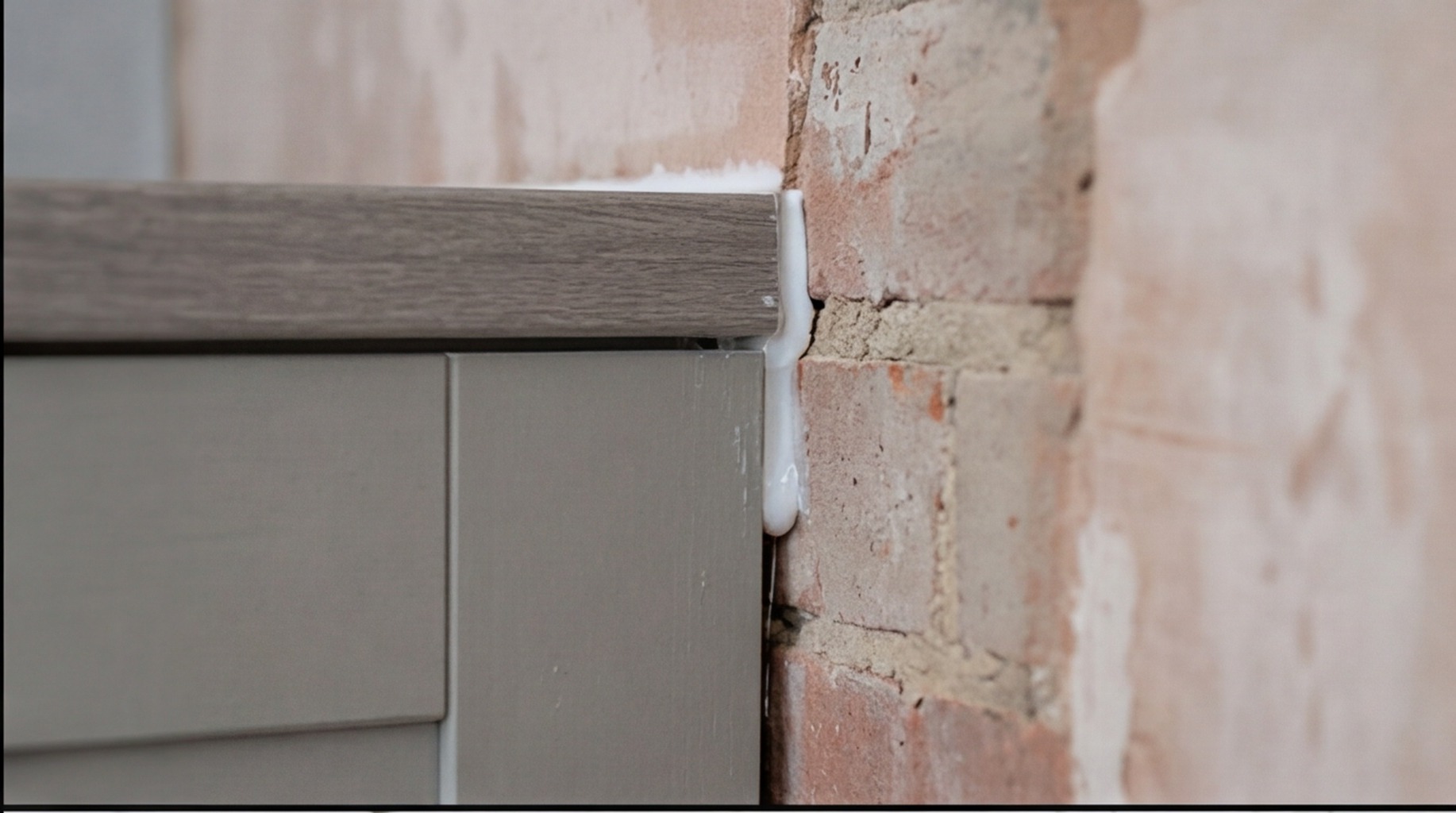
Gaps Between Kitchen Units and Wall — Causes and Solutions
Gaps between kitchen units and walls are closed using scribed filler panels — strips of matching material cut to follow the exact contour of the wall surface. This technique accommodates any degree of wall unevenness and produces a clean, gap-free finish without requiring any remedial plastering.
- Gaps against walls almost always result from the wall being out of plumb or uneven — not from the unit being incorrectly positioned.
- Scribing is the correct solution: the filler panel is scribed to match the wall profile exactly, then cut with a jigsaw.
- Our installation price includes all necessary filler panels, scribed and fitted — no extras for this common requirement.
The Problem
Gaps between units and walls are common where walls are out of plumb, uneven or where filler panels haven't been correctly scribed.
In most UK homes — particularly those built before the 1990s — walls are not perfectly flat or plumb. Plasterwork applied by hand varies by up to 10–15 mm across a single wall, and in some properties the variation is far greater, particularly in chimney breast alcoves or around window reveals. When a base or wall unit is fitted flush against such a wall, a gap opens wherever the wall recedes — an untidy result that is both visually poor and a trap for moisture and debris.
The problem is most visible at the end of a run of base units, where the final unit abuts the wall at ninety degrees, and at the top of wall units, where the gap between the carcass and the ceiling is often filled with a cornice or pelmet that cannot follow a complex wall profile. Without careful scribing, these transition points look unfinished, regardless of the quality of the units themselves.
The Solution
Scribing filler panels to the exact wall profile eliminates gaps cleanly. Our installation includes all filler panels, scribed and fitted to the wall contour.
Scribing is the process of transferring the exact wall contour onto a filler panel and cutting to match. The filler — typically a strip of carcass material or matching door material — is held against the wall and a compass or scriber is run along the wall surface, drawing a line on the panel that mirrors every dip and bump. The panel is then cut along this line and fitted, pressing tightly against the wall and leaving no gap.
Beyond filler panels, coving and cornice can also be scribed to follow a ceiling that is not perfectly flat. Worktop end panels are scribed to the wall before being fitted, and tall larder units often require scribing at both sides and the top. Experienced fitters treat scribing as a routine part of the job — it is one of the clearest differentiators between a professional installation and a rushed one. The result is a kitchen that looks as though it was built into the room, rather than placed inside it.
How a Survey Prevents This
During our £195 pre-installation survey, the fitter assesses the straightness and plumb of each wall that units will be fixed to or abut. Where walls are significantly uneven, the survey notes the maximum gap that will need to be filled, and the installation quote includes the cost of all filler panels required. There are no surprises on installation day — the fitter arrives prepared to scribe every panel that needs it.
To book your pre-installation survey, call Install My Kitchen on 07399 651836 or visit our survey page. We cover Coventry, the West Midlands and the surrounding area — survey appointments are typically available within two weeks.
Frequently Asked Questions
Not as a rule. Standard wall variations can be handled through scribing and packing without replastering. We would only advise replastering if walls were severely damaged, heavily textured, or if you were having a full refurbishment that included decoration anyway.
Sometimes — many retailers include standard filler panels as part of the kitchen design. However, they may not be the correct width or material to scribe neatly to your particular walls. We can advise at survey stage whether the panels supplied are suitable.
Internal corners that are not square are handled using scribed filler panels on one or both sides, or by adjusting the position of the corner unit within the run. Our survey measures internal angles at every corner so the fitter knows what to expect before starting.
Explore More
- Kitchen Doors Not Aligned — Why It Happens and How to Fix It
- Kitchen Worktop Joint Problems — Gaps, Swelling and Leaks
- Kitchen Plinth Fitting Problems — Gaps, Buckling and Uneven Floors
- Book a survey — avoid these problems £195 pre-installation survey — credited back on booking.
- 10 installation mistakes to avoid The most common kitchen installation mistakes and how to prevent them.
- Installation checklist Everything you need to prepare before your installation date.
- What is kitchen snagging? What snagging is and why it matters for a quality finish.
- Kitchen snagging guide Our complete guide to kitchen snagging and how we handle it.
- About Pindi — 30 years experience Meet your installer.
- Completed installations Real kitchens we have fitted across Coventry, Warwickshire and Berkshire.
- Cost guide Full breakdown of kitchen installation costs.
Book a Survey to Avoid Installation Problems
Our £195 pre-installation survey identifies issues before they happen — fixing floors, walls, deliveries and specification before your fitter arrives. Credited back in full when you proceed.