
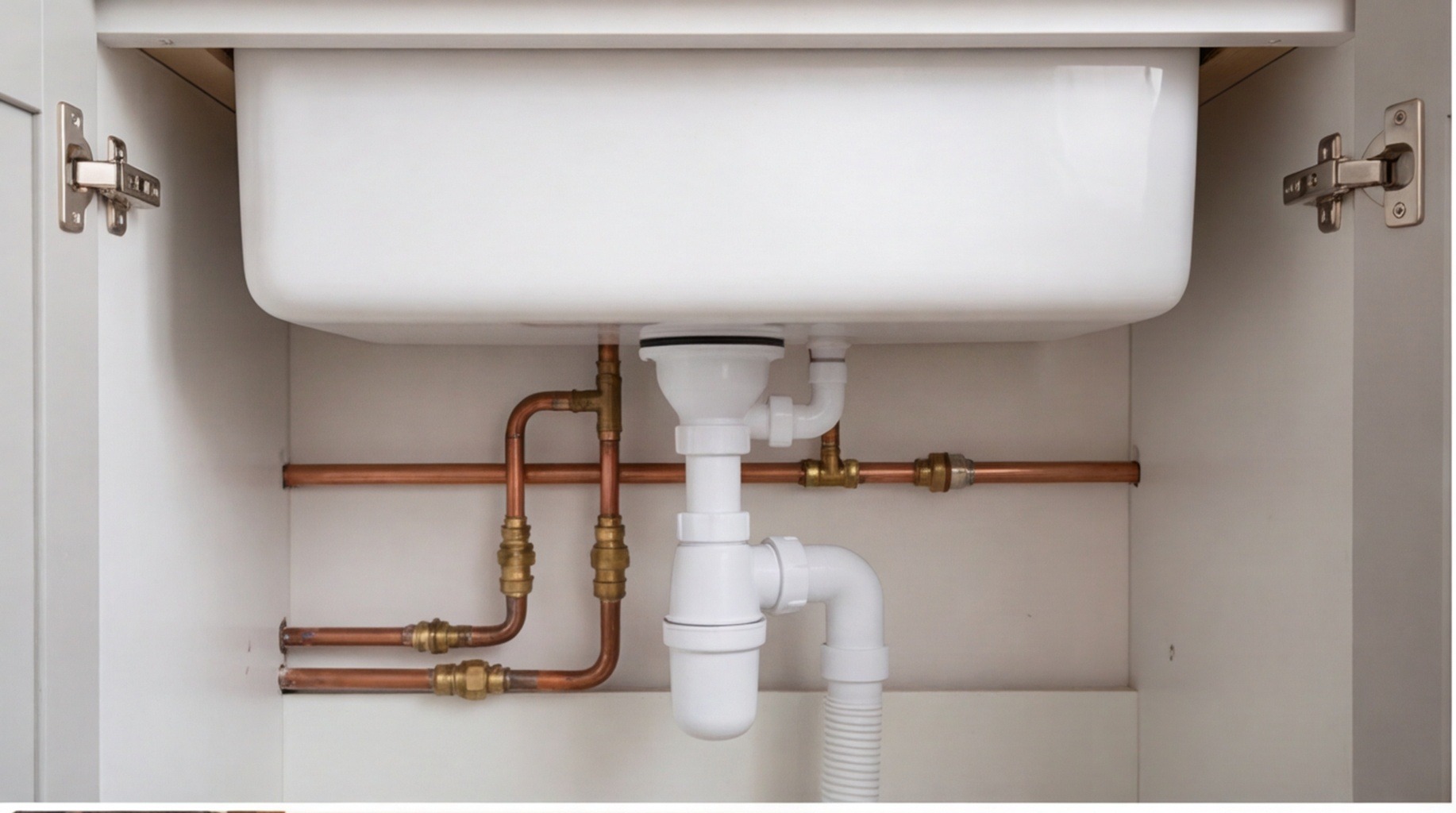
Kitchen Sink Installation Problems — Leaks, Alignment and Drainage
Kitchen sink problems — leaks, poor drainage and uneven sitting — are almost always caused by an imprecise worktop cutout, incorrect clip tension, or an inadequate seal between the sink and worktop. A correctly installed sink sits level in a precisely cut aperture, is clipped uniformly, and is sealed with a continuous bead of silicone that is compressed by the clips before it cures.
- The worktop cutout must be precisely sized — too large and the sink drops, too small and it will not seat correctly against the underside of the worktop.
- Sink clips must be tightened evenly and progressively around the perimeter — over-tightening one side causes the sink to tilt.
- Drainage installation is second-fix plumbing work and must be carried out by, or co-ordinated with, a qualified plumber.
The Problem
An incorrectly fitted sink can leak at the seal, not drain properly, or sit unevenly in the worktop cutout.
A kitchen sink is subjected to significant mechanical stress during daily use — the weight of dishes, pans and water bearing down on a single suspended point. If the worktop aperture is not the correct size, the sink will either drop through (too large) or fail to seat flat against the underside of the worktop (too small). In either case, the seal between sink and worktop will be compromised, and water will eventually find its way between the two surfaces and into the unit below. With a laminate worktop, even a small and intermittent water leak is sufficient to begin the process of core swelling described elsewhere on this site.
Drainage problems in sinks are usually not an installation issue in the conventional sense — they result from inadequate trap depth, incorrect waste alignment, or a blocked trap rather than from the sink fitting itself. However, poor initial installation of the waste outlet — using insufficient thread sealant, cross-threading the waste fitting, or failing to bed the waste on the correct washer — can result in a slow drip beneath the sink that is not noticed until significant damage has occurred. This is another reason why plumbing connections should be made by, or checked by, a qualified plumber.
The Solution
We cut all worktop apertures for sinks and hobs with precision. Sink clips are fitted per manufacturer specification. Plumbing connections are made by a qualified plumber as second-fix.
The worktop aperture for a sink is cut using a jigsaw with a fine-tooth blade, working from a template or from the dimensions provided in the sink manufacturer's installation instructions. The cut line is marked precisely, and the cut is made slightly inside the marked line — the fit is then refined with a file or belt sander until the sink seats correctly. For undermount sinks, which are bonded to the underside of the worktop, the cut must be made from below and the edges routed smooth, as the cut edge is visible from above.
Sink clips are inserted into the channel around the underside rim of the sink and tightened in a sequence that progresses evenly around the perimeter — alternating sides, much like tightening wheel nuts on a car. Each clip is tightened by hand first, then with a screwdriver, and the sequence is repeated until all clips are uniformly tight and the sink rim is in full contact with the silicone bead beneath it. The excess silicone that squeezes out from the top seam is removed while still wet, and the seal is left to cure for 24 hours before the sink is put into use.
How a Survey Prevents This
Our £195 pre-installation survey confirms the sink position, the worktop material, and the plumbing supply and waste positions. Where existing supply and waste connections are in positions that conflict with the planned sink location, the survey flags this and we advise on the cost of having a plumber reposition the connections before installation day. Plumbing is always second-fix — fitted after units and worktops are in place — and the survey ensures our fitter and your plumber are working to a co-ordinated plan.
To book your pre-installation survey, call Install My Kitchen on 07399 651836 or visit our survey page. We cover Coventry, the West Midlands and the surrounding area — survey appointments are typically available within two weeks.
Frequently Asked Questions
Water under a sink is most commonly caused by one of three sources: a leak at the waste outlet (the plastic fitting where the waste pipe connects to the sink bowl), a leak at the tap connection (the flexible hoses connecting the tap to the water supply), or a failure of the seal between the sink rim and the worktop. Each has a distinct location — waste outlet drips appear at the base of the waste fitting, tap connection drips at the supply fittings, and rim seal failures appear as damp around the inside edge of the sink cutout.
Not always. Undermount sinks require a worktop material that can be routed cleanly and will not absorb water at the cut edge — they are appropriate for stone, solid surface and thick laminate but not standard 38 mm laminate. Inset sinks (which sit on top of the worktop in a cutout) can be fitted in any worktop material. Belfast and farmhouse sinks require a modified base unit to support the weight and accommodate the apron front.
In most cases, the fitter installs the sink and the tap body (the tap itself is inserted through the tap hole and the back nut tightened from below), and the plumber connects the flexible supply hoses to the water supply. This is the most efficient approach as the fitter has the sink accessible before it is lowered into the worktop cutout, making tap installation straightforward. The plumber's work is second-fix and typically follows the worktop installation by one to two days.
Explore More
- Retailer Installation vs Independent — Why We Recommend Independent
- Kitchen Units Not Level — How to Fix It
- Gaps Between Kitchen Units and Wall — Causes and Solutions
- Book a survey — avoid these problems £195 pre-installation survey — credited back on booking.
- 10 installation mistakes to avoid The most common kitchen installation mistakes and how to prevent them.
- Installation checklist Everything you need to prepare before your installation date.
- What is kitchen snagging? What snagging is and why it matters for a quality finish.
- Kitchen snagging guide Our complete guide to kitchen snagging and how we handle it.
- About Pindi — 30 years experience Meet your installer.
- Completed installations Real kitchens we have fitted across Coventry, Warwickshire and Berkshire.
- Cost guide Full breakdown of kitchen installation costs.
Book a Survey to Avoid Installation Problems
Our £195 pre-installation survey identifies issues before they happen — fixing floors, walls, deliveries and specification before your fitter arrives. Credited back in full when you proceed.