
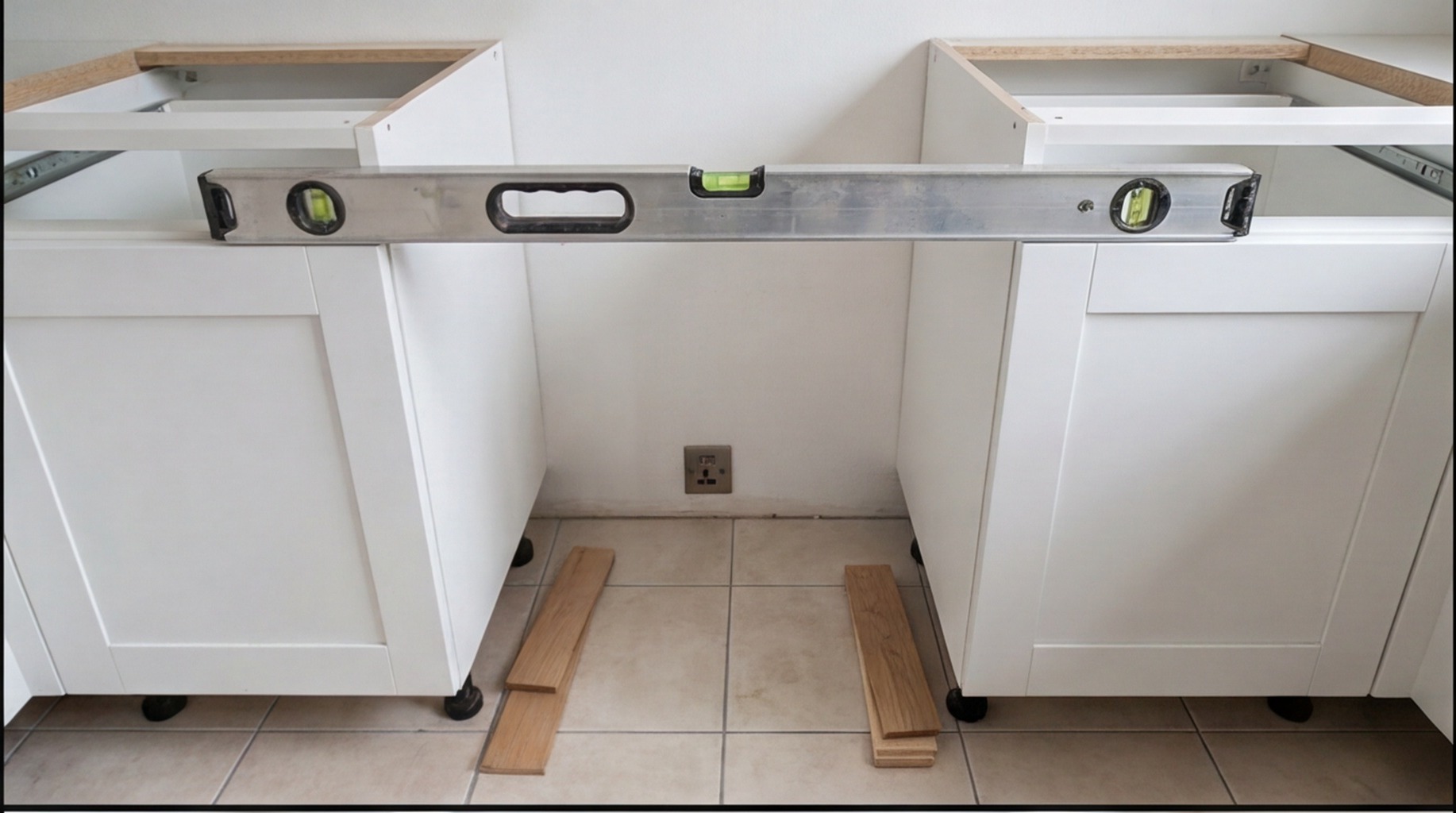
Kitchen Units Not Level — How to Fix It
Unlevel kitchen units are corrected by using a spirit level and adjustable leg plinths at every cabinet. A pre-installation survey identifies floor and wall variations beforehand, so units are installed level and plumb from the start — preventing door, drawer and worktop alignment problems.
- Unlevel units are the root cause of the majority of kitchen door and drawer alignment faults.
- Adjustable cabinet legs and packing pieces allow precise levelling even on significantly uneven floors.
- A pre-installation survey maps floor and wall levels before ordering, preventing problems rather than correcting them.
The Problem
Unlevel kitchen units cause alignment issues with doors, drawers and worktops — and can even affect appliance function. This is one of the most common problems in DIY or rushed kitchen installations.
Kitchen floors are rarely perfectly flat, particularly in older properties where boards have settled or concrete has been laid unevenly. Even a variation of a few millimetres across the run of base units is enough to cause cascading alignment problems — doors will hang at different heights, drawer fronts will fail to sit flush, and the worktop will rock or require excessive packing at the joint. In properties built before the 1980s, substantial floor variation is the norm rather than the exception.
Wall straightness is an equally common source of problems. Units fixed to a wall that bows outward will lean forward, making it impossible to achieve a consistent reveal between door faces. In kitchens with a tall unit run — larder units or full-height appliance housings — even a small deviation from plumb becomes visually obvious once doors are hung. The problem compounds if the floor and wall deviations run in opposing directions, as no amount of hinge adjustment will compensate for a unit that is simultaneously off-level and off-plumb.
The Solution
Professional installation uses spirit levels and packing at every stage. Our survey identifies uneven floors and walls before installation begins, ensuring units are installed level and plumb from the outset.
Adjustable cabinet legs are the primary tool for levelling base units. A good quality leg allows adjustment across a range of 100–150 mm, which is sufficient for most domestic floor variations. The fitter works from one end of the run to the other, establishing a datum level and working each unit up or down until the top of the carcass sits perfectly in plane. Once the run is level, the legs are locked and the plinth clips fitted — the plinth concealing any variation between the leg height and the floor.
For tall and wall units, horizontal alignment battens and wall plugs of varying lengths allow the fitter to bring units off a wall that is not perfectly flat. Shims and packing pieces are used at fixing points to ensure the unit face plane is consistent throughout the run. The investment in time at this stage pays dividends throughout the rest of the installation — when units are truly level and plumb, door hanging is straightforward, worktop scribing is predictable, and the finished kitchen looks the way it was designed to look.
How a Survey Prevents This
Our £195 pre-installation survey includes a thorough assessment of floor levels and wall straightness across the entire kitchen footprint. We use a long spirit level and, where needed, a laser level to map variations before installation begins. This means your fitter arrives on day one with a complete picture of the room — floor packing requirements are calculated in advance, and the risk of discovering a major level problem mid-installation is eliminated. The survey cost is credited back in full when you proceed to installation.
To book your pre-installation survey, call Install My Kitchen on 07399 651836 or visit our survey page. We cover Coventry, the West Midlands and the surrounding area — survey appointments are typically available within two weeks.
Frequently Asked Questions
Standard adjustable cabinet legs compensate for floor variations of up to 150 mm, which covers the vast majority of domestic kitchens. In more extreme cases, a raised timber platform or additional packing is used beneath the base units before legs are fitted.
It is possible to re-level units after installation, but it requires removing the plinth, decanting the cabinet contents, and adjusting the legs — and in some cases the worktop may need to be lifted or re-cut. It is significantly more straightforward to get levelling right during the original installation.
Yes. If base units are not level, the worktop will rock at its joints, gaps will appear at the wall, and scribing to the wall profile becomes much harder. A level base unit run is the foundation for a correctly fitted worktop.
Explore More
- Gaps Between Kitchen Units and Wall — Causes and Solutions
- Kitchen Doors Not Aligned — Why It Happens and How to Fix It
- Kitchen Worktop Joint Problems — Gaps, Swelling and Leaks
- Book a survey — avoid these problems £195 pre-installation survey — credited back on booking.
- 10 installation mistakes to avoid The most common kitchen installation mistakes and how to prevent them.
- Installation checklist Everything you need to prepare before your installation date.
- What is kitchen snagging? What snagging is and why it matters for a quality finish.
- Kitchen snagging guide Our complete guide to kitchen snagging and how we handle it.
- About Pindi — 30 years experience Meet your installer.
- Completed installations Real kitchens we have fitted across Coventry, Warwickshire and Berkshire.
- Cost guide Full breakdown of kitchen installation costs.
Book a Survey to Avoid Installation Problems
Our £195 pre-installation survey identifies issues before they happen — fixing floors, walls, deliveries and specification before your fitter arrives. Credited back in full when you proceed.